The Bible contains over 650 recorded prayers.
From Moses pleading with God after the golden calf, to Hannah weeping in the temple, to David crying from a cave, to Jesus praying in Gethsemane the night before His death — Scripture is not simply a book that teaches about prayer. It is a book full of people actually praying. Real people. Desperate people. Grateful people. Confused people. People who did not have the right words but showed up anyway.
That is what makes the Bible’s teaching on prayer trustworthy. It is not theoretical. It is documented in the lives of people who prayed in every possible circumstance and found the same thing: God hears.
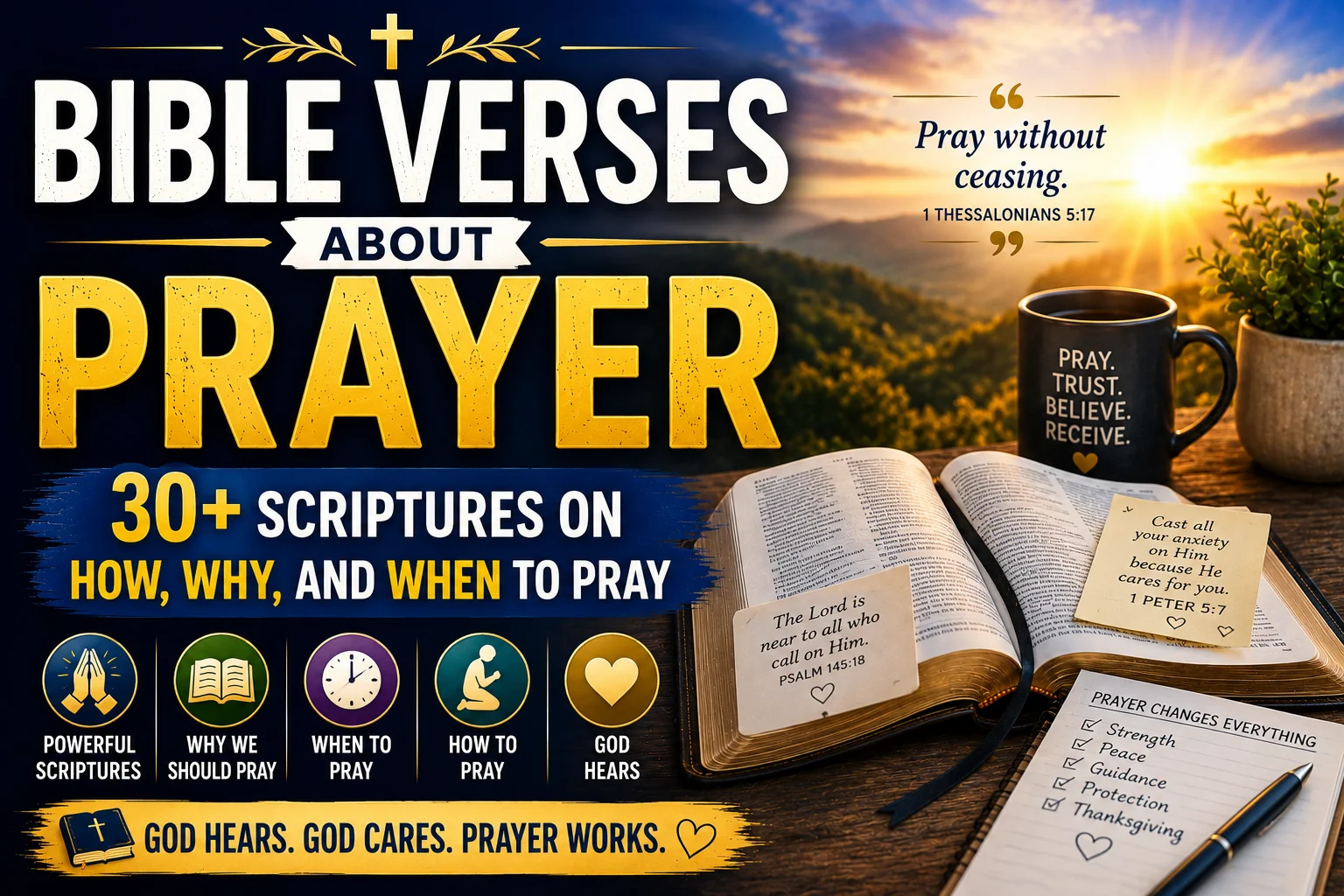
This guide organizes the Bible’s most powerful verses about prayer by topic — not as a dump of references, but with the verse text, its meaning, and how it applies to your actual prayer life. Whether you are looking for a verse to anchor your prayer practice, a scripture to pray over someone else, or simply want to understand what the Bible actually teaches about prayer — it is here.
What the Bible Says About Prayer — Overview
| Category | Key Scripture | Core Teaching |
| Why pray | Philippians 4:6–7 | Bring everything to God, receive peace |
| How to pray | Matthew 6:9–13 | Jesus modeled prayer — the Lord’s Prayer |
| When to pray | 1 Thessalonians 5:17 | Pray without ceasing — continuously |
| Praying for others | James 5:16 | Righteous intercession is powerful |
| Persistence in prayer | Luke 18:1 | Pray and do not give up |
| Answered prayer | 1 John 5:14 | Ask according to His will and He hears |
| Unanswered prayer | 2 Corinthians 12:8–9 | God’s grace is sufficient even when no is the answer |
| Prayer and faith | Matthew 21:22 | Believe when you pray |
| Corporate prayer | Matthew 18:19–20 | Agreement in prayer carries weight |
| The Spirit in prayer | Romans 8:26 | The Spirit intercedes when we don’t know what to pray |
SECTION 1: Why We Pray — Foundation Verses
Philippians 4:6–7 — The Most Practical Prayer Verse
“Do not be anxious about anything, but in every situation, by prayer and petition, with thanksgiving, present your requests to God. And the peace of God, which transcends all understanding, will guard your hearts and your minds in Christ Jesus.”
What it means: This verse does not say “do not feel anxious.” It says do not let anxiety be your only response. The alternative is prayer — specific, grateful, honest prayer. The result is not the removal of the problem but the arrival of peace that makes no logical sense given the circumstances. That peace, Paul says, guards your heart and mind — like a soldier standing watch.
This is the Bible’s clearest practical instruction for prayer: when anxiety arrives, pray. With thanksgiving. About specifics. And receive peace that transcends understanding.
1 Thessalonians 5:16–18 — Pray Without Ceasing
“Rejoice always, pray without ceasing, give thanks in all circumstances; for this is the will of God in Christ Jesus for you.”
What “pray without ceasing” actually means: This does not mean stay on your knees 24 hours a day. In the Greek, adialeiptos means “without interruption” — the way a persistent cough does not fully stop even between coughs. It describes a continuous orientation of the heart toward God throughout the day. Short prayers in traffic. A breath of gratitude before a meal no one sees. A whispered “help me” before a difficult conversation. Prayer as the background hum of a life lived toward God.
Jeremiah 29:12–13 — He Is Found When Sought
“Then you will call on me and come and pray to me, and I will listen to you. You will seek me and find me when you seek me with all your heart.”
What it means: This is one of the most personal prayer promises in the Old Testament — spoken to exiles, people who were far from home and wondering if God had forgotten them. God’s answer was not “I will make your circumstances better.” It was “call on me and I will listen. Seek me and you will find me.” The promise of prayer is not always changed circumstances. It is found God.
SECTION 2: How to Pray — What Jesus Taught
Matthew 6:9–13 — The Lord’s Prayer
“This, then, is how you should pray: ‘Our Father in heaven, hallowed be your name, your kingdom come, your will be done, on earth as it is in heaven. Give us today our daily bread. And forgive us our debts, as we also have forgiven our debtors. And lead us not into temptation, but deliver us from the evil one.'”
The structure Jesus gave: This prayer is not meant to be a script but a framework. Jesus said “pray like this” — not “pray these exact words.” The structure contains:
- Worship — hallowed be Your name
- Alignment — Your kingdom come, Your will be done
- Dependence — give us daily bread
- Forgiveness — forgive us and help us forgive
- Protection — deliver us from evil
Every prayer that follows this structure is a complete prayer.
Matthew 6:6 — Private Prayer
“But when you pray, go into your room, close the door and pray to your Father, who is unseen. Then your Father, who sees what is done in secret, will reward you.”
What it means: Jesus placed enormous value on private prayer — the kind not performed for an audience. Public prayer has its place, but the most honest prayer happens in the room with the door closed. That private prayer — however inarticulate, however short — is seen and rewarded by the Father who watches in secret.
Luke 18:1 — Persistence in Prayer
“Then Jesus told His disciples a parable to show them that they should always pray and not give up.”
What it means: Jesus told a story about a widow who kept returning to an unjust judge until he finally granted her request. His point was not that God is reluctant — it is that persistence in prayer reflects genuine faith. The person who keeps praying is the person who genuinely believes someone is listening.
SECTION 3: Bible Verses for Praying for Others
James 5:16 — The Power of Intercessory Prayer
“Therefore confess your sins to each other and pray for each other so that you may be healed. The prayer of a righteous person is powerful and effective.”
What it means: The word translated “effective” in Greek is energeo — from which we get energy. The prayer of a righteous person produces spiritual energy. It is not decorative. It accomplishes something. This verse is the biblical foundation for praying on behalf of others — and the promise is specific: it is powerful and it works.
1 Timothy 2:1 — Pray for All People
“I urge, then, first of all, that petitions, prayers, intercession and thanksgiving be made for all people.”
What it means: Paul’s instruction is comprehensive — not just friends, not just church members, not just people who deserve prayer. All people. The person who wronged you. The leader you disagree with. The neighbor you barely know. Intercessory prayer is not selective by its biblical definition.
Ephesians 6:18 — Pray for All the Saints
“And pray in the Spirit on all occasions with all kinds of prayers and requests. With this in mind, be alert and always keep on praying for all the Lord’s people.”
What it means: This verse comes at the end of the Armor of God passage — after describing all the defensive and offensive spiritual weapons. Prayer is what activates them all. Praying “in the Spirit” means praying with the Holy Spirit’s guidance, in alignment with God’s will, with the kind of sensitivity that comes from walking closely with Him.
Romans 8:26–27 — When You Don’t Know What to Pray
“In the same way, the Spirit helps us in our weakness. We do not know what we ought to pray for, but the Spirit Himself intercedes for us through wordless groans. And He who searches our hearts knows the mind of the Spirit, because the Spirit intercedes for God’s people in accordance with the will of God.”
What it means: This may be the most comforting prayer verse in Scripture for people who feel like they do not know how to pray. The Holy Spirit intercedes for you — filling in what your language cannot reach. The prayer that is too heavy for words is still heard, because the Spirit translates it.
SECTION 4: Bible Verses on Faith and Prayer
Matthew 21:22 — Ask in Faith
“If you believe, you will receive whatever you ask for in prayer.”
Important context: This verse is often taken out of context to suggest that faith guarantees any outcome. Read in full context — including 1 John 5:14 (“if we ask according to His will”) — it is clear that prayer in faith means trusting God, not demanding outcomes. Faith is not the mechanism that forces God’s hand. It is the posture that receives what God chooses to give.
1 John 5:14–15 — Confidence in Prayer
“This is the confidence we have in approaching God: that if we ask anything according to His will, He hears us. And if we know that He hears us — whatever we ask — we know that we have what we asked of Him.”
What it means: The condition is “according to His will.” Prayer aligned with God’s character, His Word, and His purposes is prayer that He hears and answers. The confidence is not in getting exactly what we want — it is in knowing that what we genuinely need, aligned with what He genuinely wills, will be provided.
Mark 11:24 — Believe When You Pray
“Therefore I tell you, whatever you ask for in prayer, believe that you have received it, and it will be yours.”
What it means: Belief in prayer is not positive thinking or emotional certainty. It is the settled confidence that God is who He says He is and will do what He promised. Praying with belief means praying without the mental escape clause: “but this probably won’t work.”
SECTION 5: Persistence and Unanswered Prayer
Psalm 34:17–18 — God Hears the Righteous
“The righteous cry out, and the Lord hears them; He delivers them from all their troubles. The Lord is close to the brokenhearted and saves those who are crushed in spirit.”
What it means: This is not a promise that the righteous never suffer — the Psalm was written by David while hiding in a cave. It is a promise about God’s posture toward those who cry out to Him. He is close, not distant. He hears, not ignores.
2 Corinthians 12:8–9 — When God Says No
“Three times I pleaded with the Lord to take it away from me. But He said to me, ‘My grace is sufficient for you, for My power is made perfect in weakness.'”
The most important “unanswered prayer” in the Bible: Paul prayed three times for his thorn in the flesh to be removed. It was not. God’s answer was not yes — it was “my grace is sufficient.” This is the most honest the Bible gets about prayer that is sincere and persistent and receives something other than what was requested. The answer is not always removal. Sometimes it is sufficiency within the difficulty.
Habakkuk 1:2 — Honest Complaint in Prayer
“How long, Lord, must I call for help, but You do not listen? Or cry out to You, ‘Violence!’ but You do not save?”
What it means: The Bible includes prayers of raw frustration and complaint — and they are presented without apology. Habakkuk essentially says: “I have been praying and I do not see You moving.” This is not faithless prayer. It is honest prayer. God honoured it with a response. Prayer does not need to be tidy to be genuine.
SECTION 6: Corporate and Persistent Prayer Verses
Matthew 18:19–20 — Agreement in Prayer
“Again, truly I tell you that if two of you on earth agree about anything they ask for, it will be done for them by My Father in heaven. For where two or three gather in my name, there am I with them.”
What it means: Gathered prayer — even a small gathering — carries specific weight. This verse does not mean that agreeing with someone guarantees the outcome. It means that the gathered community praying in Jesus’s name has His specific, promised presence. That is not nothing. That is everything.
Acts 1:14 — The Early Church at Prayer
“They all joined together constantly in prayer, along with the women and Mary the mother of Jesus, and with His brothers.”
What it means: Before Pentecost — before the Spirit came, before the church exploded in growth — the disciples gathered and prayed. Constantly. This was not preparation for something more important. It was the most important thing. What followed prayer was not coincidence.
SECTION 7: Famous Quotes About Prayer
These are not Scripture — but they are reflections on Scripture from believers who prayed seriously.
| Quote | Author |
| “Prayer is not asking. Prayer is putting oneself in the hands of God.” | Mother Teresa |
| “To be a Christian without prayer is no more possible than to be alive without breathing.” | Martin Luther King Jr. |
| “Seven days without prayer makes one weak.” | Allen Vander Griend |
| “Prayer does not change God, but it changes him who prays.” | Søren Kierkegaard |
| “You can do more than pray after you have prayed, but you cannot do more than pray until you have prayed.” | A.J. Gordon |
| “Prayer is the slender nerve that moves the muscles of omnipotence.” | Charles Spurgeon |
| “The purpose of prayer is not to get man’s will done in heaven, but to get God’s will done on earth.” | Warren Wiersbe |
Bible Verses by Topic — Quick Reference
| Need | Bible Verse | Core Promise |
| Anxiety and peace | Philippians 4:6–7 | God’s peace guards heart and mind |
| Continuous prayer | 1 Thessalonians 5:17 | Pray without ceasing |
| Praying for others | James 5:16 | Righteous prayer is powerful and effective |
| Not knowing what to pray | Romans 8:26 | Spirit intercedes with wordless groans |
| Persistence | Luke 18:1 | Pray and do not give up |
| Answered prayer | 1 John 5:14 | Ask according to His will and He hears |
| Unanswered prayer | 2 Corinthians 12:9 | His grace is sufficient |
| Corporate prayer | Matthew 18:19–20 | Where two agree, God is present |
| How to pray | Matthew 6:9–13 | The Lord’s Prayer as framework |
| Private prayer | Matthew 6:6 | God sees and rewards secret prayer |
| Seeking God | Jeremiah 29:12–13 | Seek with all your heart and you will find |
| Complaint prayer | Habakkuk 1:2 | Honest frustration is valid prayer |
Frequently Asked Questions
Q: What is the most powerful Bible verse about prayer?
Different verses speak to different needs. Philippians 4:6–7 is the most practically powerful for daily anxiety. James 5:16 is the most powerful for intercessory prayer. Matthew 21:22 is the most powerful for faith in prayer. Romans 8:26 is the most comforting for moments when words fail. There is no single most powerful verse — the power is in matching the right Scripture to the right moment.
Q: What does “pray without ceasing” mean?
It means maintaining a continuous orientation of the heart toward God throughout the day — not necessarily formal kneeling prayer at all times. Short whispered prayers, moments of gratitude, internal conversations with God during ordinary activities — all of these are part of praying without ceasing. It describes prayer as a lifestyle rather than a scheduled event.
Q: What does the Bible say about praying for others?
James 5:16 (“the prayer of a righteous person is powerful and effective”), 1 Timothy 2:1 (“pray for all people”), and Ephesians 6:18 (“keep on praying for all the Lord’s people”) are the primary verses. The Bible consistently treats intercessory prayer — praying on behalf of others — as one of the most significant things a believer can do.
Q: What Bible verse says to pray for one another?
James 5:16 is the most direct: “pray for each other so that you may be healed.” Galatians 6:2 (“carry each other’s burdens”) and Ephesians 6:18 (“always keep on praying for all the Lord’s people”) are also frequently used for this purpose.
Q: Why does God sometimes not answer prayer?
The Bible addresses this honestly. Sometimes God’s answer is no — as with Paul’s thorn in the flesh (2 Corinthians 12:8–9). Sometimes the answer is wait — as with many of the Psalms. Sometimes what feels like unanswered prayer is actually prayer that has not yet reached its appointed time. The honest biblical picture is that God always hears (1 John 5:14) but does not always respond in the way or timing we request. His answer is always rooted in perfect knowledge of what is actually best.
Q: What is a good scripture for starting a prayer?
Psalm 5:3 (“In the morning, Lord, You hear my voice; in the morning I lay my requests before You and wait expectantly”) is a beautiful morning prayer anchor. Psalm 139:1–4 (“You have searched me, Lord, and You know me”) is powerful for opening honest prayer. Hebrews 4:16 (“Let us approach God’s throne of grace with confidence”) is excellent for beginning any prayer that requires boldness.
Conclusion
Every theological statement about prayer in Scripture is surrounded by actual prayers.
The verses about God hearing do not stand alone — they are surrounded by David crying from a cave, Hannah weeping in a temple, Elijah sitting under a broom tree asking to die, Paul writing from prison about the peace that surpasses understanding.
The Bible does not present prayer as a spiritual discipline for the advanced. It presents prayer as the natural response of anyone who genuinely believes that God is real, is listening, and is worth talking to.
That includes you. In whatever state you are in. With whatever words you can find. At whatever hour of whatever day.
He hears.
“The righteous cry out, and the Lord hears them.” — Psalm 34:17

Albert Matha is a dedicated writer and the voice behind PrayerLifeHub, sharing meaningful prayers and faith-based content to inspire hope, healing, and spiritual growth. He is passionate about helping individuals and couples find peace, strength, and guidance through the power of prayer.