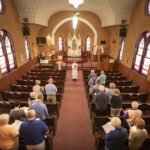
There is a chapel in almost every Catholic parish that most parishioners walk past without going in.
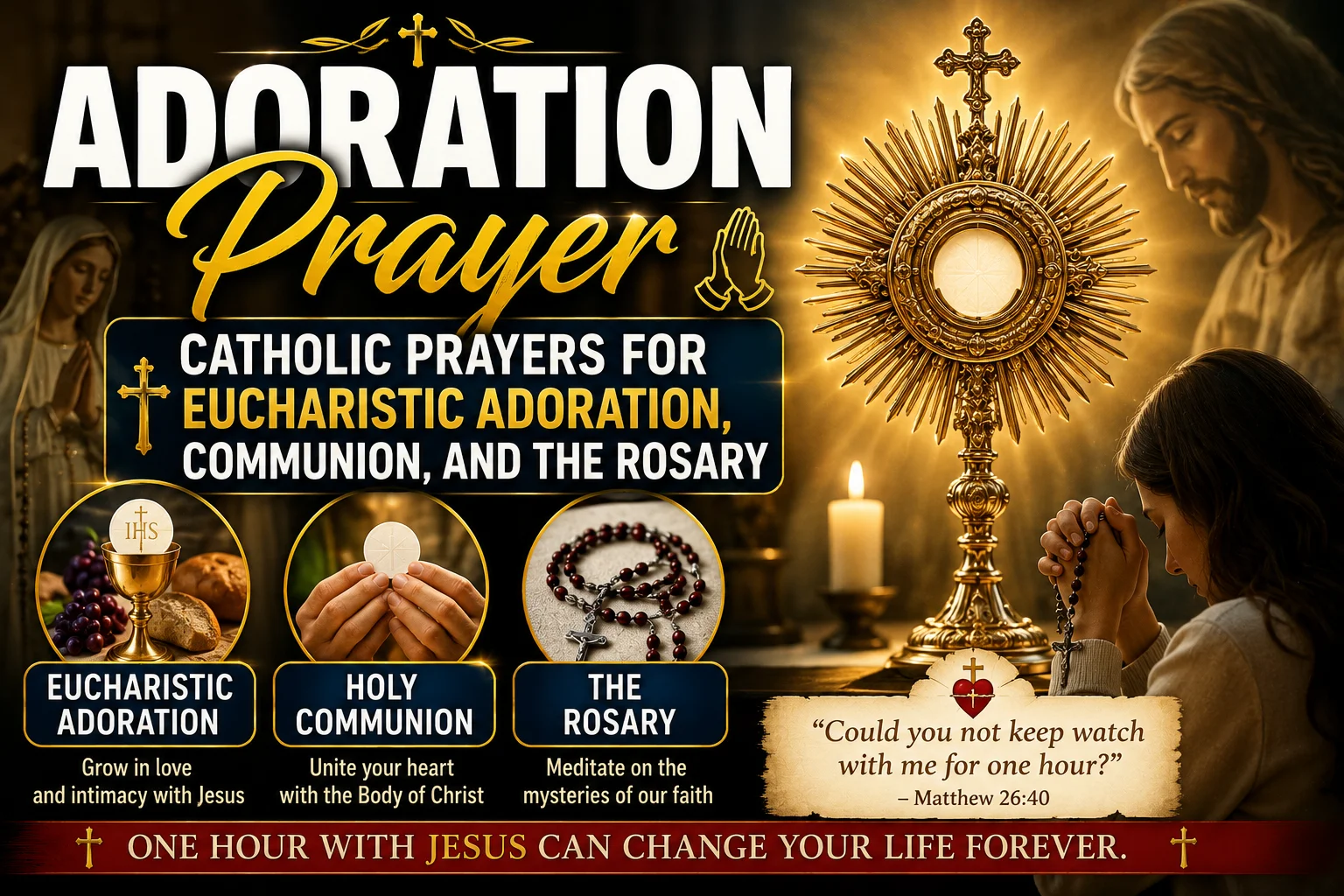
A small room, or a side altar, or sometimes a dedicated building — with a golden monstrance holding the Blessed Sacrament, candles burning, and a handful of people sitting in silence before the exposed Eucharist.
For those who understand what is happening there, it is one of the most intimate moments of Catholic devotional life. For those who have never experienced it — or who grew up Catholic but never really learned what to do — it can feel mysterious, intimidating, or simply unclear.
This guide removes the mystery.
It gives you prayers for Eucharistic Adoration, prayers before and after Mass and Communion, the prayer after the Rosary, the Golden Arrow prayer with its full history, and an honest answer to one of the most common questions about Catholic prayer: do Catholics actually pray to saints, and if so, why?
Whether you are a lifelong Catholic looking for deeper prayer resources, someone returning to the faith, or simply curious about what happens in those quiet chapel hours — this guide is for you.
What Is Eucharistic Adoration?
Eucharistic Adoration is the Catholic practice of praying in the presence of the Blessed Sacrament — the consecrated Host — which Catholic theology holds to be the real presence of Jesus Christ.
| What Happens | Why It Matters |
| The consecrated Host is placed in a monstrance — a gold vessel designed for display | Catholics believe this is literally the body of Christ, not a symbol |
| Candles are lit and the faithful kneel or sit in prayer | The setting reflects the reverence due to the Eucharist |
| People come and go or stay for extended periods | There are no rules about length — even five minutes is meaningful |
| Silence is generally maintained | It is a listening posture, not primarily a speaking one |
| Benediction may conclude the period of adoration | A formal blessing with the Blessed Sacrament |
Pope John Paul II said: “The visit to the Blessed Sacrament is a great treasure of the Catholic faith. It nourishes social love and gives us opportunities for adoration and thanksgiving, for reparation and supplication.”
What to Say and Do During Eucharistic Adoration
Many Catholics, especially those newer to the practice, are unsure what to actually do during adoration. The answer is simpler than it feels:
You do not need to say anything specific. Adoration is primarily about presence — being with Jesus, not performing for Him.
That said, many people find it helpful to have a structure. Here is a simple guide:
| Activity | What It Involves |
| Quiet presence | Simply sit or kneel, aware of who is in the monstrance |
| Personal prayer | Speak to Jesus as you would a trusted friend |
| Scripture reading | Bring a Bible or use a prayer app |
| The Rosary | Many pray one or more decades during adoration |
| The Divine Mercy Chaplet | Particularly appropriate during adoration |
| Journaling | Writing prayers or reflections |
| Intercession | Bringing specific people or situations before God |
| Simply resting | Contemplative silence — receiving rather than speaking |
The key is showing up. What happens after that can be whatever is genuine.
Opening Prayer Before Eucharistic Adoration
“Lord Jesus, I believe You are truly present here. Not symbolically. Not metaphorically. Here — in this Host, in this place, at this moment.
I do not always understand what that means. I do not always feel what I think I should feel. But I come anyway.
Teach me how to be present to You. Because You have always been present to me. Amen.”
Bible Verse:
“Where can I go from Your Spirit? Where can I flee from Your presence?” — Psalm 139:7
Prayers During Eucharistic Adoration
Prayer of Adoration:
“O Lord my God, I adore You. Not because of what You give me. Not because of what I need. But because of who You are.
You are holy. You are worthy. You are the beginning and the end of everything worth knowing.
Let me stay here long enough to remember that. Amen.”
Prayer of Reparation:
“Lord Jesus, I come before You in reparation. For the times the Eucharist has been received without thought. For the indifference that can settle into what should be wonder. For my own failures of reverence — in the liturgy, in prayer, in how I have treated the gift You gave.
Forgive what needs forgiving. Restore what has grown cold. And let this hour begin a renewal that outlasts the hour. Amen.”
Prayer of Petition During Adoration:
“Lord, I bring before You everything I am carrying today. The things I have been praying about for a long time. The things I am afraid to pray for. The people who need what I cannot give them.
I place it all at the foot of this altar. You see it. You hold it. I trust You with it. Amen.”
Closing Prayer at the End of Adoration:
“Lord, I have to go now. The hour is ending and the world requires my attention again. But You are not ending when I leave this chapel. You are not only present in the monstrance. You are present everywhere I am going.
Let what happened here — however quiet, however ordinary it felt — follow me out. Let the peace of this presence stay. Amen.”
SECTION 1: Prayer Before Mass
“Lord, I am preparing to enter Your house. Before the liturgy begins. Before the readings. Before the homily. Before the Eucharist.
Prepare what needs to be prepared — not the building, but me. Remove any distraction that would keep me from receiving what You want to give. Remove any pride that would resist what I need to hear. Remove the familiarity that can turn worship into routine.
Let me be genuinely present to what is about to happen. Through Christ our Lord. Amen.”
Bible Verse:
“I was glad when they said to me, ‘Let us go to the house of the Lord.'” — Psalm 122:1
SECTION 2: Prayer Before Communion
The prayer before receiving Communion is one of the most intimate in Catholic liturgical practice. Here are both the traditional text and a personal prayer.
Traditional Act of Faith Before Communion:
“Lord, I am not worthy that You should enter under my roof, but only say the word and my soul shall be healed.” (Based on Matthew 8:8 — the centurion’s words to Jesus)
Personal Prayer Before Communion:
“Lord Jesus, I am about to receive You. What that means — truly — exceeds what I can fully comprehend. The God of the universe, present in this Host, about to be united with me.
I come not because I am worthy. I come because You said: ‘Take and eat.’ And I am taking You at Your word.
Meet me in this moment. Transform what receives You. Through Christ our Lord. Amen.”
SECTION 3: Prayer After Communion
The moments immediately after receiving Communion are considered by many spiritual directors to be the most spiritually significant in the entire Mass — a window of intimacy that deserves its own prayer.
Traditional Anima Christi (Soul of Christ) — Prayer After Communion:
“Soul of Christ, sanctify me. Body of Christ, save me. Blood of Christ, inebriate me. Water from Christ’s side, wash me. Passion of Christ, strengthen me. O good Jesus, hear me. Within Your wounds hide me. Separated from You, let me never be. From the malignant enemy, defend me. At the hour of my death, call me and bid me come unto You, That with Your saints I may praise You forever and ever. Amen.”
The Anima Christi dates to the 14th century and was deeply loved by St. Ignatius of Loyola.
Personal Prayer After Communion:
“Lord Jesus, You are here. Not metaphorically. Here.
I do not always know what to do with that. So I will simply be still. And receive what You want to give in this moment. Thank You. Amen.”
SECTION 4: Prayer After the Rosary
The Rosary traditionally ends with specific prayers. Here is the complete closing sequence.
After the final decade:
Hail Holy Queen (Salve Regina — full text in our Hail Mary guide)
Then:
“O God, whose only-begotten Son, by His life, death, and resurrection, has purchased for us the rewards of eternal life, grant, we beseech Thee, that while meditating upon these mysteries of the most Holy Rosary of the Blessed Virgin Mary, we may imitate what they contain and obtain what they promise. Through the same Christ our Lord. Amen.”
Personal Closing Prayer After the Rosary:
“Mary, I have prayed these mysteries with you. Or tried to. The mind wandered. The attention came and went. But the intention was genuine.
Take what was offered and bring it before your Son. The mysteries I pondered. The intentions I carried through each decade. And the ones I forgot to name but that God already knows.
Amen.”
The Golden Arrow Prayer — Full Text and History
What is the Golden Arrow Prayer?
The Golden Arrow Prayer is a reparation prayer reportedly given to Sister Marie of St. Peter, a Carmelite nun in Tours, France, in 1843. She reported that Jesus gave her this prayer specifically as a response to blasphemy — the taking of God’s name in vain and other sins against the Holy Name of Jesus.
The prayer spread through the Holy Face devotion and has been used in Catholic prayer since the mid-19th century. Pope Leo XIII approved the Holy Face devotion in 1885.
Full Text of the Golden Arrow Prayer:
“May the most holy, most sacred, most adorable, most incomprehensible and unutterable Name of God be always praised, blessed, loved, adored and glorified, in Heaven, on Earth, and under the Earth, by all the creatures of God, and by the Sacred Heart of Our Lord Jesus Christ, in the Most Holy Sacrament of the Altar. Amen.”
What the prayer does: It is a prayer of reparation — offering praise of God’s holy name as a “golden arrow” that wounds the heart of God with love rather than offense. Sister Marie of St. Peter described it as a weapon against blasphemy, offering honor where dishonor has been given.
Do Catholics Pray to Saints? — An Honest Answer
One of the most commonly searched questions about Catholic prayer deserves a direct answer.
The short answer: Catholics ask saints to pray for them — which is different from praying to saints as if they were God.
The fuller explanation:
| Concept | What Catholics Believe | Biblical Basis |
| Saints are alive | Those who die in Christ are alive in Him — not gone | Luke 20:38 — “He is not the God of the dead, but of the living” |
| Saints can intercede | Being alive in Christ, they can pray for those still on earth | Revelation 5:8 — heavenly beings offering prayers of the saints |
| Asking saints to pray | Same as asking a living friend to pray for you | James 5:16 — “The prayer of a righteous person is powerful” |
| God is the source | All grace comes from God — saints intercede, they do not grant | 1 Timothy 2:5 — “One mediator between God and mankind, Christ Jesus” |
When a Catholic says “Saint Anthony, pray for me” — they are not replacing God with a saint. They are asking a powerfully positioned, righteous person to add their prayer to the request. The same logic applies to asking a living friend to pray for you — only the saint is considered more proximate to God, having completed the race.
Catholics do not pray to saints instead of God. They pray with the saints, asking them to join their intercession before the one God who answers prayer.
Bible Verses for Catholic Adoration and Prayer
| Bible Verse | Focus | When to Use |
| Psalm 139:7 — “Where can I go from Your presence” | God’s omnipresence | Opening adoration prayer |
| Psalm 122:1 — “I was glad to go to the house of the Lord” | Eagerness for worship | Prayer before Mass |
| Matthew 8:8 — “Only say the word” | Unworthiness before Communion | Before Communion |
| John 6:51 — “I am the living bread” | The Eucharist itself | During adoration |
| Revelation 5:8 — “Offering the prayers of the saints” | Intercession of saints | Answering saint question |
| Luke 20:38 — “God of the living” | Saints are alive in Christ | Context for saint intercession |
| James 5:16 — “Righteous prayer is powerful” | Why ask saints to pray | Foundation of intercession |
| 1 Timothy 2:5 — “One mediator” | Christ alone is mediator | Theological balance |
Frequently Asked Questions
Q: What is an adoration prayer?
An adoration prayer is any prayer offered in the presence of the Blessed Sacrament during Eucharistic Adoration — a Catholic devotional practice where the consecrated Host is displayed for prayer and worship. It can be a traditional Catholic prayer, personal conversation with Jesus, Scripture reading, or contemplative silence. The opening adoration prayer and the prayers during adoration in this guide are designed specifically for this context.
Q: What should I say during Eucharistic Adoration?
You do not need to say anything specific. Adoration is primarily about presence — being with Jesus. Many Catholics find it helpful to begin with the opening prayer in this guide, then move into personal prayer, Scripture reading, the Rosary, or simply sitting in quiet. A helpful principle is: talk less, listen more. The practice of simply resting in God’s presence without an agenda is one of the most valuable things adoration offers.
Q: What is the prayer after Communion?
The traditional prayer after Communion is the Anima Christi (Soul of Christ, sanctify me…) — a 14th-century prayer deeply loved by St. Ignatius of Loyola. The complete text is in this guide. A simpler personal prayer is also included for those who find the traditional text difficult to pray authentically. The moments immediately after Communion are considered among the most spiritually significant in the Mass.
Q: What is the Golden Arrow Prayer?
The Golden Arrow Prayer is a reparation prayer received by Sister Marie of St. Peter, a French Carmelite nun, in 1843. It was given as a response to blasphemy — offering praise of God’s holy name where dishonor has been given. The full text begins: “May the most holy, most sacred, most adorable Name of God be always praised…” It is associated with the Holy Face devotion, approved by Pope Leo XIII in 1885.
Q: Do Catholics really pray to saints?
Catholics ask saints to intercede — which is different from praying to them as if they were God. The theological logic is: saints who have died in Christ are still alive in Him, still able to pray, and especially positioned before God. Asking a saint to pray for you is the same logic as asking a living friend to pray for you — only the saint is considered more proximate to God. All grace comes from God. The saints intercede; God answers.
Q: How long should I spend in Eucharistic Adoration?
There is no required length. Five minutes of genuine presence is more valuable than an hour of distracted presence. Many parishes offer one-hour time slots for those who want to commit regular time. For those new to adoration, starting with 15–20 minutes and building from there is a practical approach. The key is regularity over length.
Conclusion: The God Who Waits
There is something quietly remarkable about Eucharistic Adoration.
In an era of constant motion — of notifications and demands and the endless busyness that fills every available second — here is a God who sits and waits.
Not demanding your attention. Not competing with everything else for a slot in your schedule. Simply present. In a monstrance. In a chapel. Available to whoever shows up.
The prayer offered in that space does not need to be eloquent. The person offering it does not need to feel holy or prepared or spiritually advanced. The only requirement is showing up — which, when you think about it, is also what God has been doing the entire time.
He was there before you arrived. He will be there after you leave.
What adoration offers is not a place to perform devotion. It is a place to receive presence — the same Real Presence that the disciples encountered in the breaking of bread at Emmaus, when they finally recognized who had been with them the whole time.
“Stay with us, Lord.” — Luke 24:29

Albert Matha is a dedicated writer and the voice behind PrayerLifeHub, sharing meaningful prayers and faith-based content to inspire hope, healing, and spiritual growth. He is passionate about helping individuals and couples find peace, strength, and guidance through the power of prayer.