There is a phrase in Jewish tradition that captures one of the most beautiful expressions of faith in any spiritual heritage: Refuah Shleimah — complete healing.
Not partial healing. Not physical improvement alone. Not the mere absence of symptoms. Complete healing — of body, of soul, of spirit — offered as a prayer from one person’s heart to God on behalf of another.
This is the heartbeat of Jewish healing prayer. It reflects a tradition that has, for thousands of years, understood that human beings are more than bodies, that illness touches more than flesh, and that the appropriate response to suffering is not silence but sincere, communal, faith-filled prayer.
Whether you are Jewish and seeking the traditional words of your heritage, a caregiver seeking comfort for someone you love, or simply someone drawn to the profound healing prayers of Jewish tradition — this guide gives you everything. The most important prayers, their Hebrew and English texts, their meaning, their history, and how to use them with sincerity and understanding.
What Is Jewish Healing Prayer — And What Makes It Unique
Jewish prayer for healing operates from a foundational belief: God is the ultimate healer — Rofeh Cholim — the One who heals the sick. This is not a metaphor. It is a theological conviction that runs from the earliest books of the Hebrew Bible through the modern prayerbook.
What makes Jewish healing prayer distinctive:
| What Makes It Unique | What This Means in Practice |
|---|---|
| Healing is communal | The sick are named publicly in synagogue so the community prays together |
| Healing is holistic | Refuah Shleimah covers body AND soul — both dimensions are always included |
| Healing is connected to ancestors | Mi Sheberach links current suffering to the blessings of the founding patriarchs and matriarchs |
| Psalms carry healing power | Tehillim (Psalms) are recited as a living spiritual practice, not just as text |
| Prayer accompanies medicine | Jewish tradition affirms that prayer and medical treatment work together |
“I am the Lord who heals you.” — Exodus 15:26
The Hebrew name for this aspect of God — Adonai Rofecha — appears in Exodus after the Israelites crossed the sea. God’s healing nature is part of His foundational self-revelation. Healing prayer is therefore not a request to an indifferent God but an appeal to the One who already defines Himself as the Healer.
The Mi Sheberach — The Most Important Jewish Healing Prayer
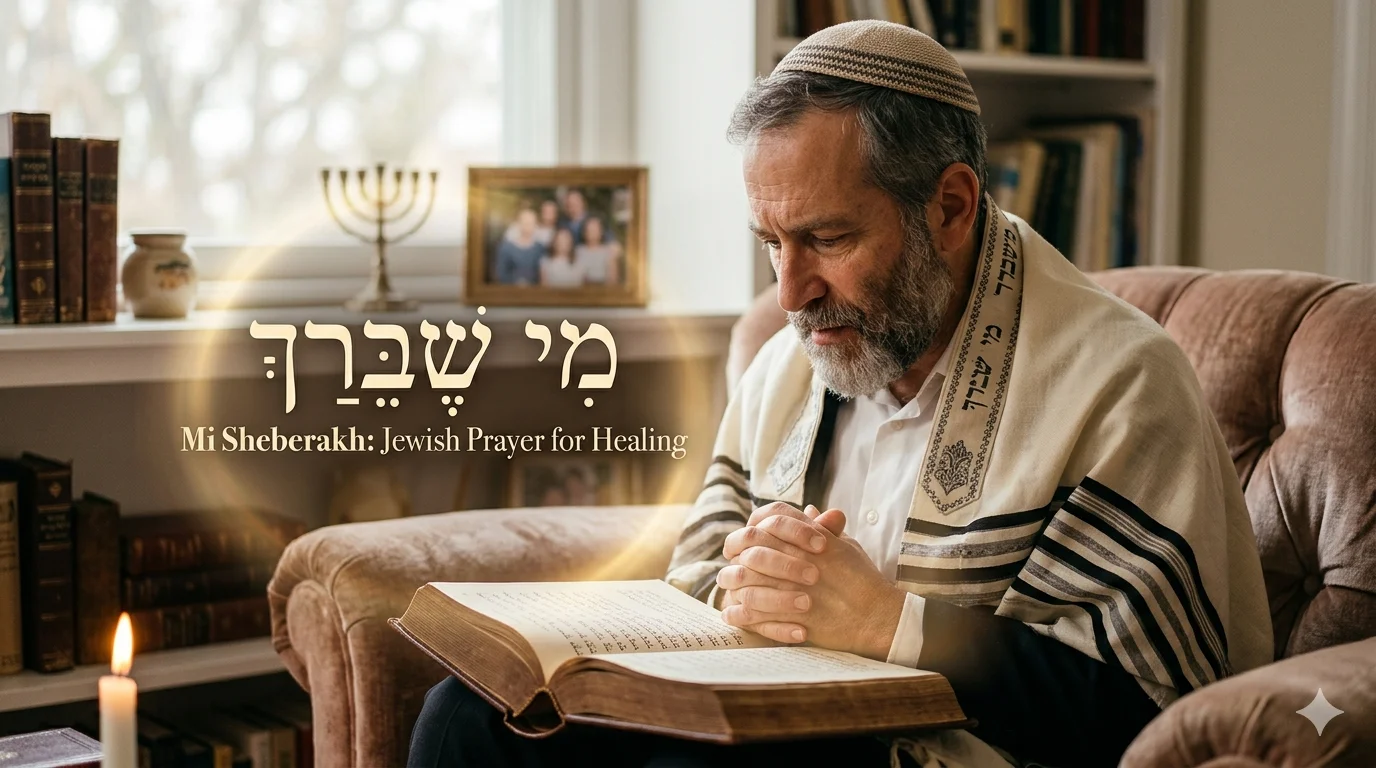
Mi Sheberach literally means “May He who blessed” — and it is the opening of the most widely known and deeply loved healing prayer in Judaism.
Origin and History
The Mi Sheberach has been part of Jewish liturgy for centuries. It is traditionally recited in synagogue during Torah readings — a moment considered spiritually elevated, when the community is gathered and the sacred text is open. The rabbi or congregation leader asks for names of those in need of healing, and the prayer is spoken over each person.
In modern times, the musician and cantor Debbie Friedman wrote a musical version of the Mi Sheberach in the late 20th century that became beloved across all Jewish denominations. Her melody has introduced the prayer to an entire generation of Jewish people and is widely sung in Reform, Conservative, and Reconstructionist synagogues.
The Traditional Mi Sheberach — Hebrew and English
Hebrew transliteration:
Mi sheberach avoteinu, M’kor habrachah l’imoteinu May the source of strength who blessed the ones before us Help us find the courage to make our lives a blessing And let us say, Amen.
Mi sheberach imoteinu, M’kor habrachah l’avoteinu Bless those in need of healing with refuah shleimah The renewal of body, the renewal of spirit And let us say, Amen.
Traditional formal English version:
“May the One who blessed our ancestors — Abraham, Isaac, and Jacob, Sarah, Rebecca, Rachel, and Leah — bless and heal the one who is ill: [Name], child of [Mother’s name].
May the Holy Blessed One be filled with compassion to restore their health, to heal them, to strengthen them, to enliven them.
May the One send them, speedily, a complete healing — healing of soul and healing of body — along with all who are ill.
Soon, speedily, without delay — and let us say, Amen.”
How to Use the Mi Sheberach
- In synagogue: The name of the ill person is usually given as their Hebrew name and their mother’s Hebrew name (e.g., Rivka bat Miriam — Rivka, daughter of Miriam).
- At home: Say the name in whatever form feels natural and meaningful to you.
- For yourself: Yes, the Mi Sheberach can be said for oneself as well as for others.
- Non-Jewish use: Many people outside the Jewish faith have found comfort in this prayer — its universal message of compassion and complete healing transcends denomination.
The Refa’enu — The Daily Healing Blessing in the Amidah
While the Mi Sheberach is the most visible healing prayer in Judaism, the Refa’enu is actually part of every Jewish person’s daily prayer — recited three times each day as part of the Amidah (the central standing prayer of Jewish liturgy).
This places healing prayer not as a response to crisis alone, but as a daily practice woven into the fabric of Jewish life.
English translation of Refa’enu:
“Heal us, O Lord, and we shall be healed. Save us and we shall be saved, for You are our praise. Grant complete healing for all our ailments, for You, God and King, are a faithful and compassionate healer. Blessed are You, Lord, who heals the sick of His people Israel.”
Hebrew transliteration:
“Refa’enu Adonai v’neirafe, hoshi’enu v’nivashe’a, ki tehilatenu ata. V’ha’ale rfu’a shleima l’chol makoteinu… Baruch Ata Adonai, rofeh cholei amo Yisrael.”
This blessing is the eighth blessing of the Amidah. Within it, a person may add a personal prayer for a specific sick person, making it both communal and deeply personal.
Tehillim — Psalms for Healing in Jewish Tradition
Tehillim (Psalms) are one of the most ancient and cherished forms of Jewish healing practice. The entire book of Psalms — 150 chapters — is traditionally attributed to King David, who himself experienced illness, persecution, grief, and miraculous deliverance.
Reciting Tehillim for a sick person is considered an act of love and intercession. During times of serious illness, Jewish communities sometimes organize groups to complete the entire book of Psalms together — dividing the chapters among participants so the whole Tehillim is covered collectively.
Key Psalms for Healing — Text and Meaning
Psalm 20 — A Prayer for Help in Times of Trouble
“May God answer you in times of trouble; may the name of the God of Jacob protect you. May He send you help from the sanctuary and grant you support from Zion. May He give you the desire of your heart and make all your plans succeed.”
This Psalm is traditionally recited for those facing crisis, illness, or danger. It is a communal prayer — spoken in the plural — expressing solidarity with the one who suffers.
Psalm 121 — The Guardian of Israel
“I lift up my eyes to the mountains — where does my help come from? My help comes from the Lord, the Maker of heaven and earth. He will not let your foot slip — He who watches over you will not slumber. The Lord will keep you from all harm — He will watch over your life. The Lord will watch over your coming and going both now and forevermore.”
Psalm 121 is one of the most universally beloved Psalms for healing, comfort, and protection. It declares that divine watchfulness is total, constant, and personal.
Psalm 130 — A Prayer from the Depths
“Out of the depths I cry to You, Lord. Lord, hear my voice. Let your ears be attentive to my cry for mercy. With the Lord is unfailing love and with Him is full redemption.”
This Psalm is prayed for those in the deepest suffering — when healing feels far away and the only language available is honest desperation. It is a prayer that gives voice to grief without abandoning faith.
Psalm 23 — The Lord Is My Shepherd
“The Lord is my shepherd; I lack nothing. He makes me lie down in green pastures, He leads me beside quiet waters, He refreshes my soul. Even though I walk through the darkest valley, I will fear no evil, for You are with me. Surely Your goodness and love will follow me all the days of my life.”
Perhaps the most universally comforting Psalm ever written — for the sick, for the dying, for those who sit beside them. It is recited in Jewish tradition at times of illness, death, and mourning.
A Table of Jewish Healing Prayers — At a Glance
| Prayer | When Used | Who Says It | Key Theme |
|---|---|---|---|
| Mi Sheberach | Synagogue Torah readings, personal prayer | Community, rabbi, family | Complete healing of body and soul |
| Refa’enu | Three times daily (Amidah) | Individual in daily prayer | God as faithful healer of His people |
| Tehillim / Psalms | Anytime, especially illness | Individual or group | Comfort, hope, petition to God |
| Modeh Ani | Every morning upon waking | Individual | Gratitude for life restored through the night |
| Shehecheyanu | Upon recovery or milestone | Individual | Gratitude for reaching this moment |
Personal Healing Prayers — For Yourself and Others
Beyond the formal liturgy, Jewish tradition has always honored the sincere personal prayer — spoken from the heart in one’s own language.
Prayer for Your Own Healing
“Master of the Universe, You know the pain I am carrying. You see the part of my body that is struggling, the part of my heart that is afraid, the part of my spirit that is worn down by this illness.
I come before You not with polished words but with honest need. Heal me. Not just the surface — the deep places. Restore my strength, restore my hope, restore the version of myself that I am reaching toward on the other side of this.
You are Rofeh Cholim — the One who heals the sick. I am sick. And I trust You. Amen.”
Prayer for Someone Else Who Is Ill
“Ribbono Shel Olam — Master of the Universe, I bring before You the name of someone I love who is suffering. [Name] needs what I cannot give. Medical care is important and I am grateful for it. But You alone can reach the place where medicine does not.
Bring them Refuah Shleimah — complete healing. Of the body that is struggling. Of the heart that is afraid. Of the spirit that needs renewal.
Be near to them in the hospital room, at home, in the quiet hours when fear is loudest. Let them feel that they are not alone. And let healing come — speedily, without delay. Amen.”
Prayer for Emotional and Spiritual Healing
“Avinu Shebashamayim — our Father in heaven, The wound I carry today is not visible on the outside. It lives in the place where words come from before they are spoken. In the grief I have not fully processed. In the fear that will not fully quiet. In the distance I feel from peace that I once knew.
Heal my soul. Restore what has been worn down by the accumulation of hard things. Light what has grown dark. And remind me — gently, as many times as I need to hear it — that You are the same God who healed before and who heals still. Amen.”
A Short Prayer for Any Moment
“Rofeh Cholim — Healer of the sick — heal [name]. Complete healing. Quickly. With compassion. Amen.”
Refuah Shleimah — Understanding the Full Meaning
The phrase Refuah Shleimah appears at the heart of Jewish healing prayer and deserves careful understanding.
| Word | Hebrew Meaning | Deeper Meaning |
|---|---|---|
| Refuah | Healing / cure | The restoration of what was broken |
| Shleimah | Complete / whole | Not partial — encompassing every dimension |
| Together | Complete healing | Body, soul, emotion, spirit — the whole person |
The word Shleimah shares its root with Shalom — peace. A Refuah Shleimah is therefore not just the absence of sickness. It is the restoration of wholeness, peace, and completeness. This is why Jewish healing prayer always addresses both body and soul — because true healing means being whole again in every dimension.
How and When to Say Jewish Healing Prayers
| Situation | Recommended Prayer | Notes |
|---|---|---|
| In synagogue during Torah reading | Mi Sheberach | Give the person’s Hebrew name and mother’s Hebrew name |
| Daily personal prayer | Refa’enu (8th blessing of Amidah) | Add personal names within the blessing |
| Visiting someone who is ill | Psalm 121 or personal prayer | Presence and prayer together are especially meaningful |
| When a group gathers | Full Tehillim rotation | Divide chapters among participants to complete all 150 |
| For emotional or spiritual suffering | Psalm 130 or personal prayer | Especially powerful for depression, grief, or trauma |
| Upon recovery or milestone | Shehecheyanu blessing | Gratitude for reaching this moment |
| Any time, anywhere | Short personal prayer | “Rofeh Cholim — heal [name]. Complete healing. Amen.” |
Frequently Asked Questions
Q: What is the most important Jewish prayer for healing?
The Mi Sheberach is the most widely recognized and communally practiced healing prayer in Judaism. However, the Refa’enu blessing — recited three times daily in the Amidah — is arguably the most consistent healing prayer in Jewish life because it is part of every day, not only times of crisis.
Q: What does Refuah Shleimah mean?
It means complete healing — of both body and soul. The word Shleimah shares its root with Shalom (peace), meaning wholeness and completeness. A Refuah Shleimah is not just physical recovery but the restoration of the whole person.
Q: How do I say the Mi Sheberach for someone who is not Jewish?
The Mi Sheberach can be said for anyone. In synagogue, the person’s name and their mother’s name are traditionally used. For someone without a Hebrew name, the English name is perfectly acceptable. The prayer’s heart — compassion and the desire for complete healing — is universal.
Q: What Psalms are best for healing in Jewish tradition?
Psalms 20, 23, 121, and 130 are the most commonly recited for healing. Psalm 121 (God watches over coming and going) and Psalm 23 (the Lord is my shepherd) are particularly beloved for comfort during illness.
Q: Can the Mi Sheberach be said for oneself?
Yes. While it is traditionally a communal prayer said for others, a person may absolutely say the Mi Sheberach for their own healing. The Amidah’s Refa’enu blessing is also specifically designed for personal daily recitation.
Q: What is Tehillim and how is it used for healing?
Tehillim is the Hebrew word for Psalms. In Jewish tradition, reciting Tehillim for a sick person is considered a powerful act of intercession. During serious illness, communities sometimes complete the entire book of 150 Psalms collectively, dividing chapters among members so the whole Tehillim is covered together.
Q: Can someone who is not Jewish use these prayers?
Absolutely. The Mi Sheberach’s message of compassion and the desire for complete healing speaks to something universal in the human heart. Many people of different faith backgrounds or no specific faith affiliation have found these prayers deeply meaningful.
Conclusion
The Jewish prayers for healing in this guide are not historical artifacts. They are living prayers — spoken today in hospitals and synagogues, at bedsides and in morning prayers, in Hebrew and in a hundred other languages by people who carry the same need every human being has ever carried: the hope that God is listening, that healing is possible, and that no one has to suffer in silence or alone.
Whether you say the ancient words of the Mi Sheberach, add a name to the Refa’enu in your morning Amidah, or simply stand beside someone who is suffering and whisper a Psalm — you are participating in something thousands of years old and still fully alive.
Refuah Shleimah — complete healing — to all who need it.
“Heal us, O Lord, and we shall be healed. Save us and we shall be saved, for You are our praise.” — From the Refa’enu blessing

Albert Matha is a dedicated writer and the voice behind PrayerLifeHub, sharing meaningful prayers and faith-based content to inspire hope, healing, and spiritual growth. He is passionate about helping individuals and couples find peace, strength, and guidance through the power of prayer.