More than a billion Catholics pray the Hail Mary every day.
In cathedrals in Rome. In small homes in rural Mexico. In hospitals across Latin America. In the fingers of elderly grandmothers working wooden rosary beads. In the whispered prayers of people who reach for it when they have no other words.
The Hail Mary is not a prayer Catholics invented. It is assembled almost entirely from Scripture — two moments in the Gospel of Luke where the presence of God arrived in the form of two greetings spoken to Mary, the mother of Jesus.
And in Spanish-speaking countries, where Catholicism runs as deep as language itself, the Ave María is as familiar as a heartbeat.
This guide gives you the full Hail Mary prayer in Spanish and English, a word-by-word translation, a pronunciation guide, the biblical source of every phrase, the Hail Holy Queen (Salve Regina) in both languages, and honest answers to the questions most people have about praying to Mary.
The Hail Mary — English Full Text
“Hail Mary, full of grace, The Lord is with thee. Blessed art thou among women, And blessed is the fruit of thy womb, Jesus. Holy Mary, Mother of God, Pray for us sinners, Now and at the hour of our death. Amen.”
Ave María — Spanish Full Text (Hail Mary in Spanish)
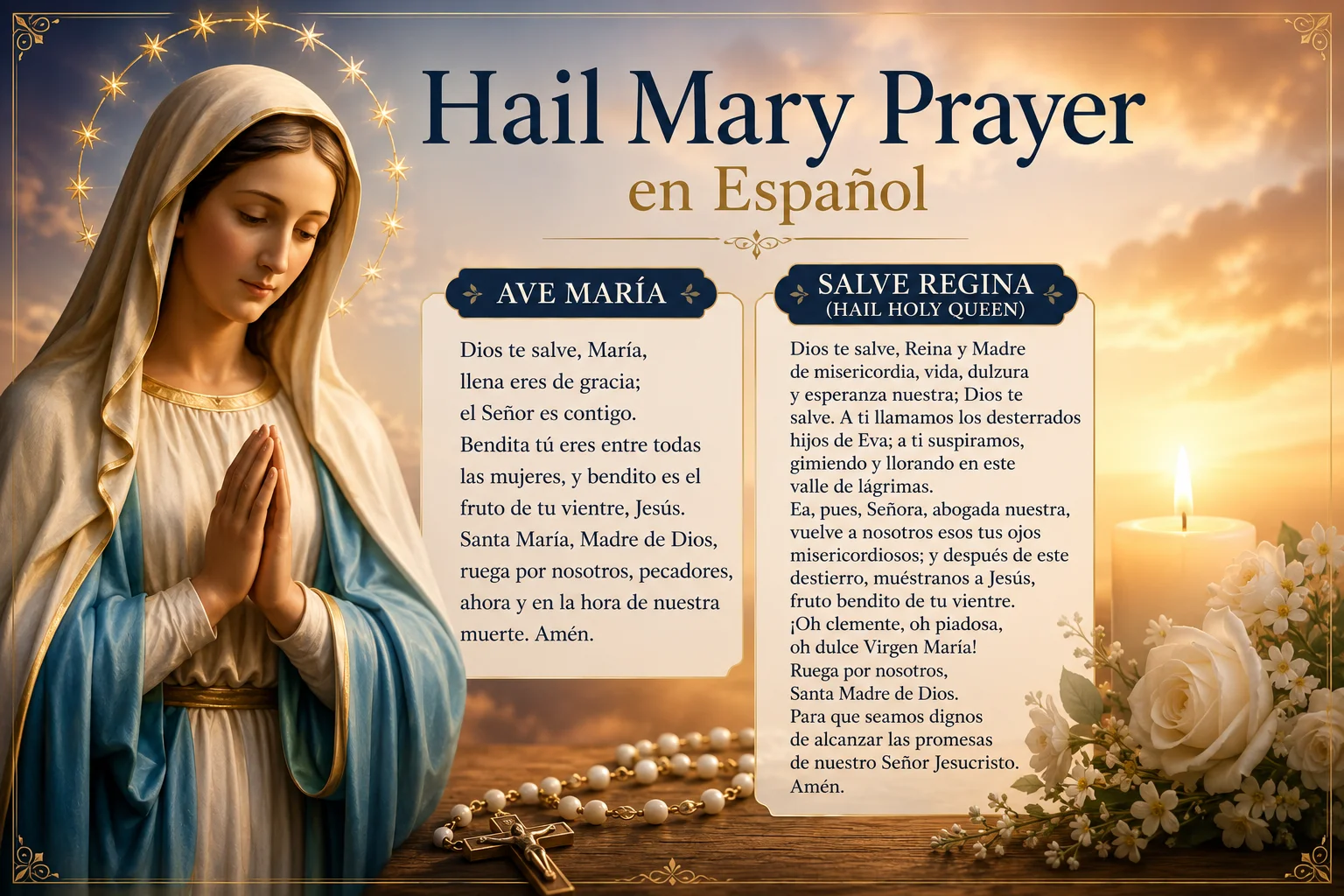
“Dios te salve, María, llena eres de gracia, el Señor es contigo. Bendita tú eres entre todas las mujeres, y bendito es el fruto de tu vientre, Jesús. Santa María, Madre de Dios, ruega por nosotros pecadores, ahora y en la hora de nuestra muerte. Amén.”
Word-by-Word Translation — Spanish to English
| Spanish | English | Notes |
| Dios te salve, María | God save you, Mary | Lit. “God save you” — more than just “Hail” |
| llena eres de gracia | full of grace you are | From Gabriel’s greeting, Luke 1:28 |
| el Señor es contigo | the Lord is with you | Gabriel’s words, Luke 1:28 |
| Bendita tú eres entre todas las mujeres | Blessed are you among all women | Elizabeth’s words, Luke 1:42 |
| y bendito es el fruto de tu vientre | and blessed is the fruit of your womb | Elizabeth’s words, Luke 1:42 |
| Jesús | Jesus | Name added in liturgical tradition |
| Santa María | Holy Mary | Beginning of petition added in 15th century |
| Madre de Dios | Mother of God | Council of Ephesus 431 AD title — Theotokos |
| ruega por nosotros pecadores | pray for us sinners | Intercessory request |
| ahora y en la hora de nuestra muerte | now and at the hour of our death | Two most critical moments of life |
| Amén | Amen | So be it |
Pronunciation Guide — How to Say the Ave María
For Spanish learners and those who want to pray it correctly:
| Phrase | Pronunciation |
| Dios te salve, María | DYOS teh SAL-veh, mah-REE-ah |
| llena eres de gracia | YEH-nah EH-res deh GRAH-syah |
| el Señor es contigo | el seh-NYOR es kon-TEE-goh |
| Bendita tú eres | ben-DEE-tah too EH-res |
| fruto de tu vientre | FROO-toh deh too VYEN-treh |
| Santa María, Madre de Dios | SAN-tah mah-REE-ah, MAH-dreh deh DYOS |
| ruega por nosotros pecadores | RWEH-gah por noh-SOH-tros peh-kah-DOH-res |
| en la hora de nuestra muerte | en lah OH-rah deh NWES-trah MWER-teh |
Note: In Latin American Spanish, the “ll” in “llena” sounds like “y.” In Spanish from Spain, it sounds more like “ly.” Both are correct.
Where Each Phrase Comes From — The Biblical Sources
The Hail Mary is uniquely Scripture-based. Almost every phrase comes directly from the Gospel of Luke.
| Phrase in Prayer | Biblical Source | Context |
| “Hail, full of grace, the Lord is with thee” | Luke 1:28 | The Angel Gabriel greets Mary at the Annunciation |
| “Blessed art thou among women” | Luke 1:42 | Elizabeth greets Mary at the Visitation |
| “Blessed is the fruit of thy womb” | Luke 1:42 | Elizabeth continues her greeting |
| “Jesus” (name added) | Luke 1:31 — “you shall call His name Jesus” | Name inserted in liturgical tradition to complete the phrase |
| “Holy Mary, Mother of God” | Council of Ephesus, 431 AD | The title Theotokos (God-bearer) defined |
| “Pray for us sinners” | James 5:16 — righteous prayer is powerful | Petition added in liturgical tradition, printed 1495 |
| “Now and at the hour of our death” | Liturgical addition | The two moments of greatest need |
What this means: The first half of the Hail Mary is almost entirely Scripture — the exact words spoken to Mary by Gabriel and Elizabeth. The second half is a petition asking Mary to pray for us — which Catholic theology grounds in James 5:16 (the prayer of a righteous person is powerful and effective) and the belief that those in heaven are still alive in Christ and able to intercede.
A Note for Non-Catholics — Why Catholics Pray to Mary
If you are not Catholic, the practice of praying to Mary may feel unfamiliar or theologically unclear. Here is the honest Catholic explanation:
Catholics do not pray to Mary instead of God. They ask Mary to pray for them to God — the same way you might ask a close friend to pray for you. Catholic theology holds that Mary, being alive in Christ in heaven, is able to intercede — to add her prayer to yours before the throne of God.
The phrase “pray for us sinners” is not directed to Mary as if she were God. It is a request for her intercession — exactly as you might say to a friend: “Please pray for me.”
Whether or not one accepts Catholic theology about Marian intercession, the biblical texts that form the first half of the prayer — Gabriel’s greeting and Elizabeth’s blessing — are shared Scripture that all Christians affirm.
The Hail Holy Queen — English Full Text
The Hail Holy Queen (Salve Regina in Latin) is one of the most ancient and beloved Marian prayers in Catholic tradition. It is prayed at the end of the Rosary and has been sung in monasteries since the 11th century.
“Hail, Holy Queen, Mother of Mercy, our life, our sweetness, and our hope. To thee do we cry, poor banished children of Eve. To thee do we send up our sighs, mourning and weeping in this valley of tears. Turn then, most gracious advocate, thine eyes of mercy toward us, and after this our exile, show unto us the blessed fruit of thy womb, Jesus. O clement, O loving, O sweet Virgin Mary.
Pray for us, O Holy Mother of God, that we may be made worthy of the promises of Christ. Amen.”
Salve Regina — Spanish Full Text (Hail Holy Queen in Spanish)
“Dios te salve, Reina y Madre de misericordia, vida, dulzura y esperanza nuestra. Dios te salve. A ti llamamos los desterrados hijos de Eva. A ti suspiramos, gimiendo y llorando en este valle de lágrimas. Ea, pues, Señora, abogada nuestra, vuelve a nosotros esos tus ojos misericordiosos. Y después de este destierro, muéstranos a Jesús, fruto bendito de tu vientre. Oh clementísima, oh piadosa, oh dulce Virgen María.
Ruega por nosotros, Santa Madre de Dios, para que seamos dignos de alcanzar las promesas de Nuestro Señor Jesucristo. Amén.”
Side-by-Side: Hail Holy Queen English and Spanish
| English | Spanish |
| Hail, Holy Queen | Dios te salve, Reina y Madre |
| Mother of Mercy | de misericordia |
| our life, our sweetness, and our hope | vida, dulzura y esperanza nuestra |
| poor banished children of Eve | los desterrados hijos de Eva |
| mourning and weeping in this valley of tears | gimiendo y llorando en este valle de lágrimas |
| thine eyes of mercy toward us | esos tus ojos misericordiosos |
| show unto us the blessed fruit of thy womb | muéstranos a Jesús, fruto bendito de tu vientre |
| O clement, O loving, O sweet Virgin Mary | Oh clementísima, oh piadosa, oh dulce Virgen María |
History of the Hail Holy Queen
| Period | Development |
| 1050s | Earliest known version composed — attributed to Blessed Hermann of Reichenau |
| 11th–12th century | Adopted by Cistercian and Franciscan monasteries |
| Medieval period | Becomes standard close of Compline (night prayer) |
| 16th century | Added to end of the Rosary |
| Today | Prayed by Catholics worldwide at the close of the Rosary and Marian devotions |
The phrase “valley of tears” (valle de lágrimas) is one of the most poetic in all of Catholic prayer — an honest acknowledgment that earthly life involves real suffering, addressed to the one who herself knew suffering deeply.
The Memorare — Another Essential Marian Prayer
The Memorare is a short Marian prayer particularly beloved in moments of urgent need. It is attributed to St. Bernard of Clairvaux (1090–1153).
English: “Remember, O most gracious Virgin Mary, that never was it known that anyone who fled to thy protection, implored thy help, or sought thy intercession, was left unaided. Inspired by this confidence, I fly unto thee, O Virgin of virgins, my Mother. To thee do I come, before thee I stand, sinful and sorrowful. O Mother of the Word Incarnate, despise not my petitions, but in thy mercy hear and answer me. Amen.”
Spanish: “Acordaos, oh piadosísima Virgen María, que jamás se ha oído decir que ninguno de los que han acudido a vuestra protección, implorando vuestro socorro y demandando vuestro auxilio, haya sido desamparado de vos. Animado con esta confianza, a vos acudo, oh Madre, Virgen de las vírgenes. A vos vengo, ante vos me presento, pecador arrepentido. No despreciéis mis súplicas, antes bien, escuchadlas favorablemente. Amén.”
When Catholics Pray the Hail Mary
| Occasion | Context |
| The Rosary | Hail Mary repeated 53 times, Hail Holy Queen at the close |
| The Angelus | Three times daily — 6AM, noon, 6PM — with three Hail Marys |
| Personal devotion | Any time — in gratitude, in need, in grief |
| The Liturgy of the Hours | Certain hours include Marian antiphons |
| Novenas | Nine-day prayers often include Ave Marías |
| Before sleep | A common closing night prayer |
Frequently Asked Questions
Q: What is the Hail Mary prayer in Spanish?
The Hail Mary in Spanish is called the Ave María. The full text is: “Dios te salve, María, llena eres de gracia, el Señor es contigo. Bendita tú eres entre todas las mujeres, y bendito es el fruto de tu vientre, Jesús. Santa María, Madre de Dios, ruega por nosotros pecadores, ahora y en la hora de nuestra muerte. Amén.” The complete text with word-by-word translation appears in this guide.
Q: What is the biblical basis for the Hail Mary?
The first half comes almost entirely from Scripture. “Hail, full of grace, the Lord is with thee” comes from Luke 1:28 — the Angel Gabriel’s greeting to Mary. “Blessed art thou among women, and blessed is the fruit of thy womb” comes from Luke 1:42 — Elizabeth’s greeting. The second half (“Holy Mary, Mother of God, pray for us sinners”) is a petition added in Catholic liturgical tradition, first appearing in print in 1495.
Q: What is the Hail Holy Queen prayer?
The Hail Holy Queen (Salve Regina) is an 11th-century Marian prayer prayed at the end of the Rosary. It addresses Mary as Queen, acknowledges the suffering of earthly life (“valley of tears”), and asks her to show us Jesus. The complete English and Spanish texts appear in this guide.
Q: What does “Dios te salve, María” mean?
It literally means “God save you, Mary” — not simply “Hail Mary.” The Spanish version carries a slightly different nuance than the English — actively invoking God’s blessing on Mary rather than just offering a greeting. This reflects the phrase’s origin in Gabriel’s greeting at the Annunciation.
Q: Is it wrong for non-Catholics to pray the Hail Mary?
The first half of the prayer is Scripture — the exact words of Gabriel and Elizabeth. Any Christian can affirm those. The second half asks Mary to pray for us — which reflects Catholic theology of intercession. Non-Catholics who are uncomfortable with that can engage with the first half as a meditation on the Annunciation, or pray it as a whole while understanding that ultimate help comes from God alone.
Q: How many times is the Hail Mary prayed in the Rosary?
53 times in a standard five-decade Rosary — ten Hail Marys per decade, for five decades. The Rosary begins with an Apostles’ Creed, an Our Father, three Hail Marys, and a Glory Be before the decades begin, and concludes with the Hail Holy Queen.
Conclusion: Words That Carry Centuries
The Ave María has been prayed for over a thousand years.
It was on the lips of St. Francis of Assisi as he rebuilt his first small church. It was whispered by martyrs in Roman amphitheaters. It was sung in Gregorian chant by monks before dawn and prayed by ordinary people in the last hours of their lives.
The words themselves have not changed. The same greeting Gabriel brought to a young woman in Nazareth — “Hail, full of grace, the Lord is with you” — is the same greeting Catholics carry into their prayer today.
Whether you are praying it in Spanish for the first time, returning to it after years away, or learning what it means for the first time — these words have weight. Not because of their repetition, but because of what they point to: the moment when heaven came close enough to speak, and a young woman said yes.
“Blessed are you among women, and blessed is the fruit of your womb.” — Luke 1:42

Albert Matha is a dedicated writer and the voice behind PrayerLifeHub, sharing meaningful prayers and faith-based content to inspire hope, healing, and spiritual growth. He is passionate about helping individuals and couples find peace, strength, and guidance through the power of prayer.