Every Sunday, in every language, on every continent, the same prayer is spoken by more people than any other words in human history.
It has been prayed in cathedrals and in prisons. In hospital rooms and at gravesides. By children who barely understand what the words mean and by theologians who have spent lifetimes studying them. By people whose faith is certain and by people whose faith is barely holding on.
In Latin. In Greek. In Aramaic. In Spanish. In English — King James and modern. In hundreds of languages the disciples who first heard it could not have imagined.
The Lord’s Prayer is not simply a prayer. It is the prayer. The one Jesus gave when His disciples asked: “Lord, teach us to pray.” Everything worth knowing about prayer is somewhere in these words.
This guide gives you the full KJV text, every major version, the Spanish translation word-by-word, the line-by-line meaning of each petition, the historical and biblical context, the difference between Catholic and Protestant versions, and a guide for praying it with genuine meaning rather than routine recitation.
The Lord’s Prayer — KJV Full Text
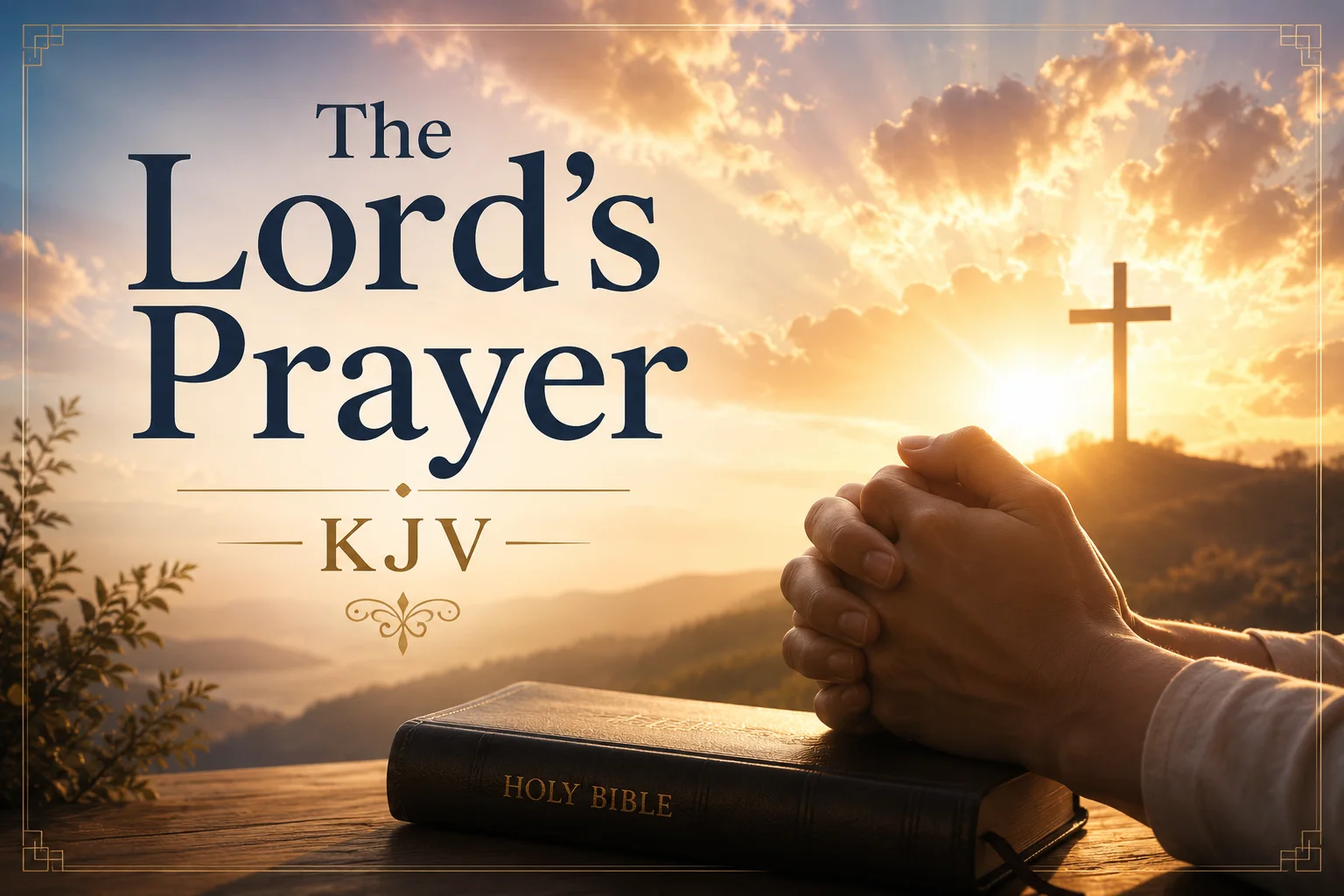
The King James Version, published in 1611, remains the most memorized English version of the Lord’s Prayer. It comes from Matthew 6:9–13.
“Our Father which art in heaven, Hallowed be thy name. Thy kingdom come, Thy will be done in earth, as it is in heaven. Give us this day our daily bread. And forgive us our debts, as we forgive our debtors. And lead us not into temptation, but deliver us from evil: For thine is the kingdom, and the power, and the glory, for ever. Amen.” — Matthew 6:9–13 (KJV)
All Major Versions Compared
Different Christian traditions use slightly different versions of the Lord’s Prayer. Here they are side by side.
| Petition | KJV (1611) | Modern/NIV | Catholic (Our Father) |
| Address | “Our Father which art in heaven” | “Our Father in heaven” | “Our Father, who art in heaven” |
| Hallowing | “Hallowed be thy name” | “hallowed be your name” | “hallowed be thy name” |
| Kingdom | “Thy kingdom come” | “your kingdom come” | “thy kingdom come” |
| Will | “Thy will be done in earth” | “your will be done on earth” | “thy will be done on earth” |
| Bread | “Give us this day our daily bread” | “Give us today our daily bread” | “Give us this day our daily bread” |
| Forgiveness | “forgive us our debts, as we forgive our debtors” | “forgive us our debts, as we also have forgiven our debtors” | “forgive us our trespasses, as we forgive those who trespass against us” |
| Temptation | “Lead us not into temptation” | “lead us not into temptation” | “lead us not into temptation” |
| Deliverance | “deliver us from evil” | “deliver us from the evil one” | “deliver us from evil” |
| Doxology | “For thine is the kingdom…” | “For yours is the kingdom…” | (Omitted in Catholic Mass) |
Why Does the Catholic Version Differ?
The most commonly asked question about the Lord’s Prayer is why Catholics omit the final doxology — “For thine is the kingdom, and the power, and the glory.”
The answer is textual: The doxology does not appear in the oldest Greek manuscripts of Matthew 6. It appears to have been added in liturgical use in the early church — a natural conclusion to the prayer modeled on Old Testament doxologies like 1 Chronicles 29:11. Protestant translations include it because their tradition relied on later manuscripts. Catholic liturgy follows the earliest manuscripts, which do not include it.
Neither is more “correct” — they reflect different manuscript traditions, both ancient and valid.
What Catholics do instead: In the Mass, after the Lord’s Prayer, the priest adds a prayer called the embolism — asking for deliverance from evil. The congregation then responds with the doxology separately: “For the kingdom, the power and the glory are yours, now and forever.”
The Lord’s Prayer — Line by Line Meaning
Most people who have prayed the Lord’s Prayer for years have never slowed down to hear what each line actually says. Here is the prayer, one petition at a time.
“Our Father which art in heaven”
The first word is “Our” — not “My.” Jesus taught His disciples to pray as a community, not as isolated individuals. From the very first word, the Lord’s Prayer places the person praying within a family — the family of God. The use of “Father” was itself radical. In Jewish prayer tradition of Jesus’s time, addressing God as Father this directly was unusual. Jesus made this intimacy the starting point of prayer.
“Hallowed be thy name”
Hallowed means honored, treated as holy, set apart. This petition is not a description — it is a request. We are asking that God’s name would be treated as holy — in our lives, in our speech, in the world. It is the first petition and it is outward-facing: before we ask for anything for ourselves, we ask that God be honored.
“Thy kingdom come, Thy will be done in earth, as it is in heaven”
This double petition holds together two realities: the kingdom that is coming and the will that should already be done. In heaven, God’s will is done completely. On earth, it is not — yet. This prayer is an alignment — asking that what is true in heaven would become true here. It is also a surrender: your will, not mine.
“Give us this day our daily bread”
Daily is a translation of the Greek epiousios — a rare word that scholars debate. It may mean “bread for today,” “bread for tomorrow,” or “essential bread.” Whatever the precise translation, the petition is simple: we need what we need, every day, and we acknowledge You as the One who provides it. This line places physical need — food — in the center of prayer. Jesus does not separate spiritual life from physical dependence.
“Forgive us our debts, as we forgive our debtors”
This is the most demanding line in the prayer. The word “as” creates a direct connection between receiving forgiveness and giving it. It is not a transaction — we do not earn forgiveness by forgiving. But Jesus links the two. In Matthew 6:14–15, immediately after the prayer, He returns specifically to this line: “If you forgive other people when they sin against you, your heavenly Father will also forgive you.” No other petition receives this follow-up.
“Lead us not into temptation, but deliver us from evil”
A theologically complex line. The Greek word translated “temptation” can mean both testing and temptation. James 1:13 says God does not tempt anyone — so this is likely a prayer about not being led into situations of testing beyond what we can bear, combined with a request for deliverance from the evil one. It is the only petition that looks forward — asking for protection in what is still ahead.
“For thine is the kingdom, and the power, and the glory, for ever”
The doxology (where included) returns to the outward, God-focused orientation with which the prayer began. It ends where it started — with God’s greatness, not our needs. The prayer opens by hallowing His name and closes by glorifying His kingdom.
The Lord’s Prayer in Spanish — Padre Nuestro
The Spanish Lord’s Prayer is called the Padre Nuestro — simply meaning “Our Father.” It is prayed by hundreds of millions of Spanish-speaking Catholics and Protestants worldwide.
Padre Nuestro — Full Spanish Text:
Padre nuestro, que estás en el cielo, santificado sea tu nombre. Venga tu reino. Hágase tu voluntad, en la tierra como en el cielo. Danos hoy nuestro pan de cada día. Perdona nuestras ofensas, como también nosotros perdonamos a los que nos ofenden. No nos dejes caer en la tentación, y líbranos del mal. Amén.
Word-by-Word Translation:
| Spanish | English |
| Padre nuestro | Our Father |
| que estás en el cielo | who art in heaven |
| santificado sea tu nombre | hallowed be thy name |
| Venga tu reino | Thy kingdom come |
| Hágase tu voluntad | Thy will be done |
| en la tierra como en el cielo | on earth as it is in heaven |
| Danos hoy nuestro pan de cada día | Give us this day our daily bread |
| Perdona nuestras ofensas | Forgive us our trespasses |
| como también nosotros perdonamos | as we also forgive |
| a los que nos ofenden | those who trespass against us |
| No nos dejes caer en la tentación | Lead us not into temptation |
| y líbranos del mal | but deliver us from evil |
| Amén | Amen |
Pronunciation Guide for Key Phrases:
- Padre nuestro — PAH-dray NWES-troh
- santificado — san-tee-fee-KAH-doh
- Hágase tu voluntad — AH-gah-say too boh-loon-TAD
- ofensas — oh-FEN-sahs
- tentación — ten-tah-SYOHN
The Lord’s Prayer in Luke vs Matthew
The Lord’s Prayer appears twice in the Gospels — in Matthew 6:9–13 and in Luke 11:2–4. They are similar but not identical.
| Element | Matthew 6:9–13 | Luke 11:2–4 |
| Address | “Our Father in heaven” | “Father” |
| Hallowing | “Hallowed be your name” | “hallowed be your name” |
| Kingdom | “your kingdom come” | “your kingdom come” |
| Will | “your will be done on earth as in heaven” | (omitted) |
| Bread | “Give us today our daily bread” | “Give us each day our daily bread” |
| Forgiveness | “as we forgive our debtors” | “for we also forgive everyone who sins against us” |
| Temptation | “lead us not into temptation, deliver from evil” | “lead us not into temptation” |
| Context | Part of Sermon on the Mount — private prayer teaching | Response to a disciple’s request: “Lord, teach us to pray” |
Why are they different? Jesus taught the prayer on different occasions. Matthew records it as part of the Sermon on the Mount. Luke records it as a response to a specific request. The slight variations reflect natural differences in how the same teaching was delivered and remembered in different communities.
How to Pray the Lord’s Prayer Meaningfully
Most people who have prayed the Lord’s Prayer for decades have done it by rote — the words leaving the mouth before the mind has caught up. Here is a simple practice for praying it with genuine intention:
The Pause Method: Pray each line, then pause. Let the content of the line become an actual thought before moving to the next.
“Our Father…” — Pause. I am addressing God as a child addresses a parent. That is the relationship.
“Hallowed be your name…” — Pause. What in my life does not honor His name right now?
“Your kingdom come, your will be done…” — Pause. Where am I currently resisting His will? What would it look like to align with it?
“Give us today our daily bread…” — Pause. What specific provision am I trusting Him for today?
“Forgive us our debts, as we forgive our debtors…” — Pause. Who do I need to forgive? Is there anything between me and God that needs clearing?
“Lead us not into temptation…” — Pause. Where is my weak point right now? Where do I need His protection most?
Praying the Lord’s Prayer this way takes three to five minutes instead of thirty seconds — but the three-to-five-minute version is genuinely prayed.
What Jesus Said About Prayer — In Context
The Lord’s Prayer appears in Matthew 6 within a larger teaching about how not to pray. Just before giving this model, Jesus warned against two things:
- Performative prayer (Matthew 6:5–6): “When you pray, do not be like the hypocrites, for they love to pray standing in the synagogues and on the street corners to be seen by others.”
- Vain repetition (Matthew 6:7–8): “And when you pray, do not keep on babbling like pagans, for they think they will be heard because of their many words.”
Then immediately: “This, then, is how you should pray…”
The Lord’s Prayer is the antidote to both of these. It is private (directed to “your Father who sees in secret”). It is brief. It is structured. And it contains everything a person needs to pray — worship, alignment with God’s will, dependence on provision, forgiveness, and protection.
Bible Verses About the Lord’s Prayer
| Bible Verse | Content |
| Matthew 6:9–13 | Primary text — Sermon on the Mount version |
| Luke 11:2–4 | Second version — shorter, in response to “teach us to pray” |
| Matthew 6:14–15 | Jesus’s follow-up specifically on the forgiveness petition |
| 1 Chronicles 29:11 | Old Testament basis for the doxology |
| Matthew 6:5–8 | The context — what not to do before the prayer is given |
Frequently Asked Questions
Q: What is the Lord’s Prayer KJV full text?
The King James Version of the Lord’s Prayer comes from Matthew 6:9–13: “Our Father which art in heaven, Hallowed be thy name. Thy kingdom come, Thy will be done in earth, as it is in heaven. Give us this day our daily bread. And forgive us our debts, as we forgive our debtors. And lead us not into temptation, but deliver us from evil: For thine is the kingdom, and the power, and the glory, for ever. Amen.” The full text appears at the top of this guide.
Q: What is the difference between the Catholic Our Father and the Protestant Lord’s Prayer?
The primary difference is the doxology — “For thine is the kingdom, and the power, and the glory, for ever.” Catholic liturgy omits this because it does not appear in the earliest Greek manuscripts of Matthew 6. Protestant versions include it based on later manuscripts. The Catholic Mass includes the doxology separately as a congregational response after a priest’s additional prayer. Both traditions pray all the core petitions identically.
Q: What is the Lord’s Prayer in Spanish?
Padre nuestro, que estás en el cielo, santificado sea tu nombre. Venga tu reino. Hágase tu voluntad, en la tierra como en el cielo. Danos hoy nuestro pan de cada día. Perdona nuestras ofensas, como también nosotros perdonamos a los que nos ofenden. No nos dejes caer en la tentación, y líbranos del mal. Amén. The complete word-by-word translation and pronunciation guide appear in this guide.
Q: Did Jesus pray the Lord’s Prayer himself?
Jesus gave the Lord’s Prayer as a model — “This is how you should pray” (Matthew 6:9). It is a prayer He taught, not one He prayed for Himself. Many of its petitions — like “forgive us our debts” — would not apply to Jesus. He prayed extensively in the Gospels, but the Lord’s Prayer is specifically designed for His followers.
Q: Why does it say “debts” in some versions and “trespasses” in others?
Both come from Matthew 6:12. The Greek word is opheilema — meaning debt or what is owed. “Debts” (KJV, NIV) is a closer translation of the Greek. “Trespasses” comes from the Latin Vulgate (peccata) and the Anglican tradition. Luke 11:4 uses a different Greek word — hamartia — which means sins. All three are used to translate the same underlying concept: the moral obligations we fail to fulfill toward God and others.
Q: How long is the Lord’s Prayer?
The KJV version contains 66 words. Luke’s version is shorter at approximately 38 words. Prayed slowly, with the pause method described in this guide, it takes three to five minutes. Prayed in the usual rush, it takes under thirty seconds. The length is less important than the attention brought to it.
Conclusion
There is a reason theologians have said that every prayer a Christian will ever need to pray is somewhere in the Lord’s Prayer.
Worship — hallowed be your name. Alignment — your will be done. Dependence — give us daily bread. Forgiveness — forgive us as we forgive. Protection — deliver us from evil.
When you do not know what to pray, the Lord’s Prayer is always the right answer. Not because it covers every specific request — it does not name the doctor’s appointment or the job interview or the broken relationship. But because it covers every category of human need before God.
Start here. Pray it slowly. Let each line become a thought before moving to the next.
In English. In Spanish. In whatever language the words reach your heart most honestly.
The Father who taught it to us is still listening.
“Our Father which art in heaven, Hallowed be thy name.” — Matthew 6:9 (KJV)

Albert Matha is a dedicated writer and the voice behind PrayerLifeHub, sharing meaningful prayers and faith-based content to inspire hope, healing, and spiritual growth. He is passionate about helping individuals and couples find peace, strength, and guidance through the power of prayer.