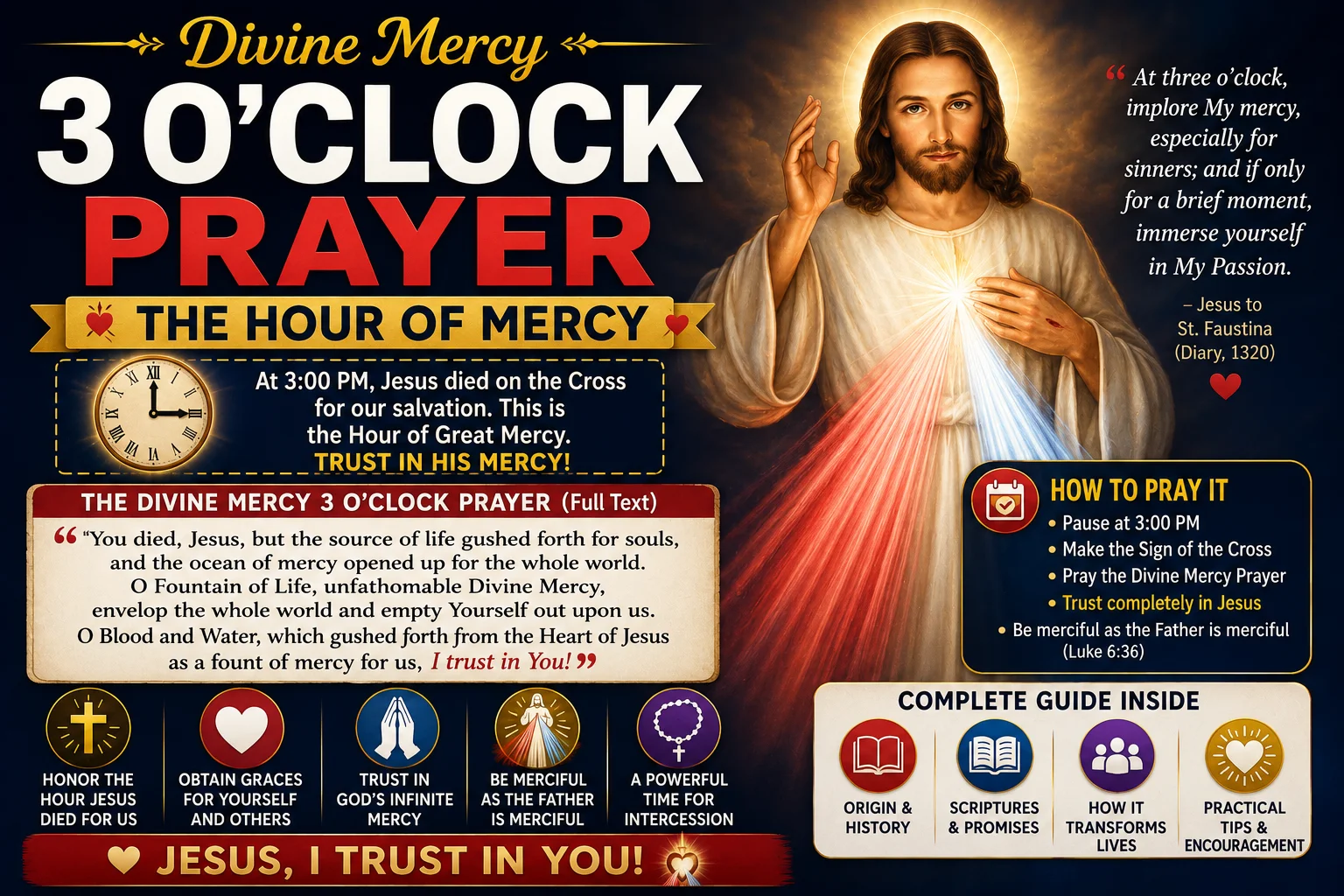
Every day at 3 o’clock in the afternoon, something significant is available to anyone willing to pause for sixty seconds.
Not a complicated ritual. Not a lengthy liturgy. Just a moment of remembrance — directed at the most significant event in human history and the mercy that flowed from it.
At 3PM on what we call Good Friday, Jesus died on the cross. That hour — documented in the Gospels as the ninth hour, the time of Jewish evening prayer — was the moment when, as St. John records, a soldier’s spear pierced His side and blood and water poured out.
It is from this historical reality that the Divine Mercy 3 O’Clock Prayer draws its meaning. Not as superstition. Not as a magical window. But as a daily, intentional act of remembrance — standing at the foot of the cross, however briefly, and receiving the mercy that was poured out there.
This guide gives you everything: the full text of the 3 O’Clock Prayer, the story of St. Faustina who received this devotion, the full Chaplet of Divine Mercy, a practical guide for making this prayer part of daily life, and honest answers to the questions most people have — including whether this prayer is only for Catholics.
Who Was St. Faustina — And Why Does She Matter?
The Divine Mercy devotion as it is practiced today traces entirely to one person: Sister Maria Faustina Kowalska — a Polish nun who lived from 1905 to 1938.
| Key Facts About St. Faustina | Details |
| Born | August 25, 1905, Głogowiec, Poland |
| Religious order | Congregation of the Sisters of Our Lady of Mercy |
| Key writing | Diary: Divine Mercy in My Soul — 1,700+ pages of spiritual experiences |
| Died | October 5, 1938, at age 33 |
| Beatified | April 18, 1993, by Pope John Paul II |
| Canonized | April 30, 2000, by Pope John Paul II |
| Feast day | October 5 |
Faustina was the third of ten children born to a poor farming family. She received minimal formal education and entered religious life at twenty. By all external measures, she was an unremarkable nun — working in kitchens and gardens, moving between convents. But from 1931 until her death, she recorded an extraordinary series of spiritual visions and messages in her diary.
The central message she recorded was simple: God’s mercy is greater than human sin. And the devotion she received was a practical way to access and share that mercy — through prayer, through the Chaplet, and through the Hour of Mercy.
Pope John Paul II — who was Polish and had a deep personal devotion to Divine Mercy throughout his life — said of Faustina’s message: “There is nothing that man needs more than Divine Mercy.”
What Is the Hour of Mercy?
The Hour of Mercy is 3 o’clock in the afternoon — the hour traditionally associated with the death of Jesus on the cross.
In Faustina’s diary, Jesus is recorded as saying:
“At three o’clock, implore My mercy, especially for sinners; and, if only for a brief moment, immerse yourself in My Passion, particularly in My abandonment at the moment of agony. This is the hour of great mercy… In this hour, I will refuse nothing to the soul that makes a request of Me in virtue of My Passion.” — Diary of St. Faustina, Entry #1320
What this means practically: The Hour of Mercy is not a mystical window where God becomes more generous than at other times. It is an invitation to remember — specifically, intentionally — what happened at 3PM on the day of the crucifixion, and to bring your petitions to God through the lens of Christ’s sacrifice.
The mercy available at 3PM is the same mercy available at every other moment. What the Hour of Mercy does is give a daily anchor point for remembering it.
The 3 O’Clock Prayer — Full Text
This is the shorter prayer for those who cannot pray the full Chaplet. It can be prayed in under sixty seconds.
Version 1 — The Primary 3 O’Clock Prayer:
“You expired, Jesus, but the source of life gushed forth for souls, and the ocean of mercy opened up for the whole world. O Fount of Life, unfathomable Divine Mercy, envelop the whole world and empty Yourself out upon us.”
(Then repeat three times:)
“O Blood and Water, which gushed forth from the Heart of Jesus as a fount of mercy for us, I trust in You!”
— Diary of St. Faustina, Entries #1319 and #84
Version 2 — A Simple 3 O’Clock Prayer:
“O Jesus, You died at this hour for love of me. You poured out Your blood and Your mercy upon the whole world. I come to You now at the hour of Your death. Have mercy on me and on the whole world. In You I trust. Amen.”
Version 3 — For When You Have Only a Moment:
“Jesus, I trust in You. Have mercy on me and on the whole world.”
These three words — “Jesus, I trust in You” — are the heart of the entire Divine Mercy devotion. They appear on the Divine Mercy image that Jesus reportedly asked Faustina to have painted.
The Full Chaplet of Divine Mercy — Step by Step
The Chaplet of Divine Mercy is a longer prayer prayed on rosary beads. It typically takes 15–20 minutes and is most commonly prayed at 3PM, though it can be prayed at any time.
What you need: A standard rosary (5 decades with a crucifix)
| Step | What to Pray | Where on Rosary |
| 1. Opening | Our Father, Hail Mary, Apostles’ Creed | On the crucifix and first beads |
| 2. Opening Verse | “Eternal Father, I offer You the Body and Blood, Soul and Divinity of Your dearly beloved Son, Our Lord Jesus Christ, in atonement for our sins and those of the whole world.” | On each large bead (10 times) |
| 3. Response | “For the sake of His sorrowful Passion, have mercy on us and on the whole world.” | On each small bead (10 times per decade) |
| 4. Repeat | Steps 2 and 3 for all five decades | Through all five decades |
| 5. Closing | “Holy God, Holy Mighty One, Holy Immortal One, have mercy on us and on the whole world.” (three times) | After the last decade |
The two key prayers of the Chaplet:
On large beads: “Eternal Father, I offer You the Body and Blood, Soul and Divinity of Your dearly beloved Son, Our Lord Jesus Christ, in atonement for our sins and those of the whole world.”
On small beads: “For the sake of His sorrowful Passion, have mercy on us and on the whole world.”
SECTION: Additional Prayers for the Hour of Mercy
Prayer for Sinners at the Hour of Mercy:
“Lord Jesus, at the hour of Your death You poured out mercy on the world. I come before You now — aware of my own need for that mercy. Not performing goodness. Not presenting credentials. Simply standing here, at the hour of Your sacrifice, and asking.
Have mercy on me. Have mercy on those I love. Have mercy on the whole world. In Your name and through Your Passion. Amen.”
Prayer for a Dying Person at 3 O’Clock:
“Lord Jesus, You experienced the moment of death at this very hour. I bring before You [name], who is approaching that same threshold. Let Your mercy — the ocean that poured from Your side — reach them now. Whatever remains between them and You — cover it. Receive them into Your mercy. Amen.”
Bible Verse for the Hour of Mercy:
“But one of the soldiers pierced His side with a spear, and immediately blood and water came out.” — John 19:34
What the Church Teaches About Divine Mercy
| Question | Church Teaching |
| Is the Divine Mercy devotion approved? | Yes — fully approved by the Catholic Church, the image, Chaplet, and Feast Day are all officially recognized |
| Is the Feast of Divine Mercy a holy day? | It is the Sunday after Easter — declared by Pope John Paul II in 2000 |
| Must Catholics pray at exactly 3PM? | No — the Church encourages it but does not require it |
| Are Faustina’s diary entries infallible? | No — private revelations are not required belief for Catholics, but this one is strongly recommended |
| Can non-Catholics pray the Chaplet? | Yes — the prayer itself is addressed to God through Christ and is available to any believer |
The Difference Between the 3AM Prayer and the 3PM Prayer
Many people searching online confuse these two practices. They are completely different.
| 3AM Prayer | 3PM (Divine Mercy) Prayer | |
| Origin | General Christian tradition of night vigil prayer | St. Faustina’s diary — specifically Catholic devotion |
| Focus | Watching and praying in the night hours | Commemorating Jesus’s death on the cross |
| Biblical basis | Mark 1:35 (Jesus prayed before dawn), Acts 16:25 | John 19:34 (blood and water from the cross) |
| Tradition | Cross-denominational | Primarily Catholic, practiced by some other Christians |
| Length | Varies | 60 seconds (short prayer) or 15–20 min (Chaplet) |
| Purpose | Intercession, spiritual alertness | Mercy, remembrance of the Passion |
Can Non-Catholics Pray the Divine Mercy Prayer?
Yes — and many do.
The theological content of the 3 O’Clock Prayer is not uniquely Catholic. It remembers the death of Jesus, acknowledges the mercy that flows from His sacrifice, and expresses trust in Him. These are foundational Christian convictions that Protestants, Orthodox Christians, and many other believers share.
The fuller Chaplet uses specific Catholic prayer forms (Our Father, Hail Mary) and a Christological offering to the Eternal Father. Non-Catholics who are uncomfortable with Marian prayer can adapt the Chaplet or use the shorter 3 O’Clock prayers instead.
The heart of the entire devotion — “Jesus, I trust in You” — is three words that any Christian in any tradition can honestly pray.
How to Make the 3 O’Clock Prayer a Daily Habit
The most common reason people do not pray at 3PM is simple: they forget. Here are practical ways to make it consistent:
| Method | How It Works |
| Phone alarm | Set a daily alarm at 3PM labeled “Hour of Mercy” |
| Hallow or Laudate app | Both have 3PM prayer reminders built in |
| Workplace practice | A brief pause — even 60 seconds at your desk |
| Car commute | If you commute around 3PM, use that time |
| Start with the short prayer | 60 seconds is better than skipping because 20 minutes is impossible |
| Pray when you remember | Faustina’s diary records Jesus saying the 3PM prayer can be prayed “even for a brief moment” |
The goal is consistency, not perfection. A sincere sixty-second prayer at 3PM every day builds something over time that an occasional long prayer cannot.
Frequently Asked Questions
Q: What is the Divine Mercy 3 O’Clock Prayer?
It is a short prayer prayed at 3PM — the hour Jesus died on the cross — asking for His mercy on ourselves and the whole world. It comes from the diary of St. Faustina Kowalska, a Polish nun canonized in 2000. The primary text begins: “You expired, Jesus, but the source of life gushed forth for souls…” The full text appears in this guide.
Q: Why is 3 o’clock called the Hour of Mercy?
Because it is the hour traditionally associated with Jesus’s death on the cross (Mark 15:34 records the ninth hour — 3PM in Roman timekeeping). St. Faustina’s diary records Jesus describing this as the hour of great mercy, when He will refuse nothing asked through His Passion. It is an invitation to pause daily and remember the sacrifice from which all mercy flows.
Q: What is the difference between the Chaplet of Divine Mercy and the 3 O’Clock Prayer?
They are related but different. The 3 O’Clock Prayer is a brief prayer (under 60 seconds) specifically for 3PM. The Chaplet of Divine Mercy is a longer prayer (15–20 minutes) prayed on rosary beads that can be prayed at any time but is most commonly prayed at 3PM. Both are covered in full in this guide.
Q: Who was St. Faustina and why should I trust her?
Faustina Kowalska was a Polish nun who died in 1938 after recording extraordinary spiritual experiences in her Diary. The Catholic Church officially approved her diary and canonized her in 2000. Her diary underwent extensive theological scrutiny before approval. The key theological content of the devotion — God’s mercy is greater than human sin — is entirely consistent with Scripture and Christian tradition regardless of whether one accepts private revelation.
Q: Can I pray the Divine Mercy prayer if I am not Catholic?
Yes. The short 3 O’Clock Prayer and especially the phrase “Jesus, I trust in You” are available to any Christian. The Chaplet uses Catholic prayer forms but its content is addressed to the Father through Christ. Many non-Catholic Christians find this devotion meaningful and practice it without adopting Catholic theology wholesale.
Q: What time exactly should I pray the 3 O’Clock Prayer?
3PM — 3 o’clock in the afternoon. If you miss it, pray it when you remember. Faustina’s diary records Jesus saying “if only for a brief moment” — suggesting that even a very short remembrance at that hour has value. The goal is intentional daily remembrance, not anxiety about the exact minute.
Conclusion
You do not need a rosary. You do not need to be Catholic. You do not need to understand everything about Divine Mercy devotion.
You need sixty seconds and a willingness to stand, however briefly, at the place where the greatest act of mercy in human history occurred.
At 3PM today, the same mercy that poured from the side of Christ on the cross is still available. It has not diminished. It has not been rationed. The ocean of mercy that St. Faustina’s diary describes is not smaller today than it was on Good Friday.
What the 3 O’Clock Prayer does is simply this: it turns your face toward it.
“Jesus, I trust in You.”
That is enough to start.
“But one of the soldiers pierced His side with a spear, and immediately blood and water came out.” — John 19:34

Albert Matha is a dedicated writer and the voice behind PrayerLifeHub, sharing meaningful prayers and faith-based content to inspire hope, healing, and spiritual growth. He is passionate about helping individuals and couples find peace, strength, and guidance through the power of prayer.