Before the prayers — one honest clarification.
Catholic prayer to saints is one of the most misunderstood practices in Christianity. Non-Catholics often ask: “Are you praying to the saints instead of God?” And Catholics sometimes struggle to explain it clearly.
The answer is no. Catholics do not pray to saints as if they were gods. They ask the saints to intercede — to pray on their behalf. The same way you might ask a friend to pray for you, Catholic tradition holds that those who have died in Christ are still alive in Him, still able to pray, and able to bring petitions before God.
“The prayer of a righteous person is powerful and effective.” — James 5:16
If that is true of the living, Catholic theology holds it is equally true of the saints in heaven — those who have already completed the race and now stand before God. Asking Saint Raphael to pray for your healing is not replacing God’s role. It is asking a powerfully positioned intercessor to add their voice to yours.
With that foundation — here are the prayers.
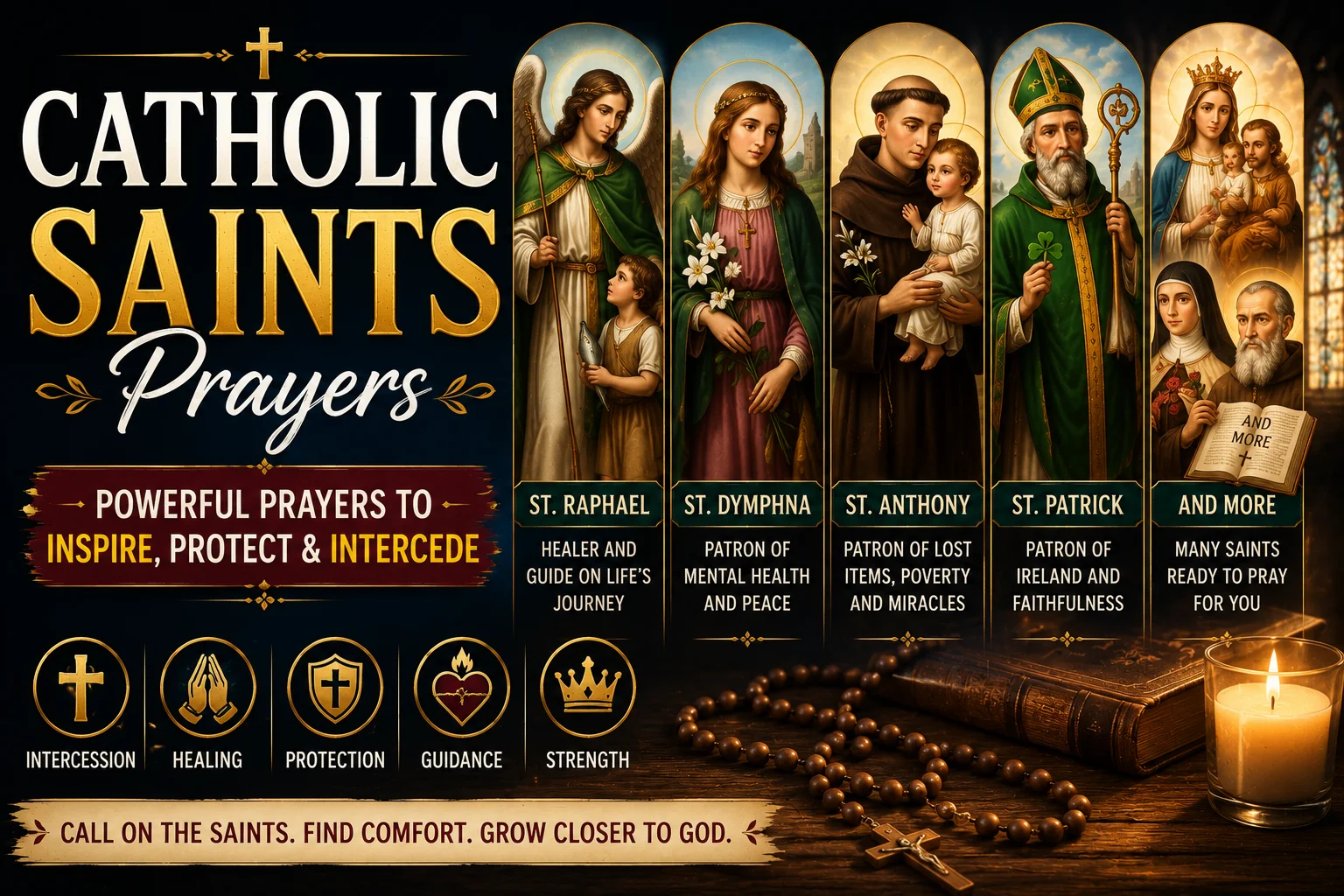
Quick Guide — Which Saint for Which Need
| Saint | Patron of | Best Known Prayer For |
|---|---|---|
| St. Raphael | Healing, travelers, happy meetings | Physical healing, finding a spouse |
| St. Dymphna | Mental health, anxiety, depression | Emotional and mental illness |
| St. Anthony | Lost things, poor people | Finding what is lost |
| St. Patrick | Ireland, against snakes, engineers | Protection, faith in difficulty |
| St. Joseph | Fathers, workers, selling property | Selling a home, work, family |
| St. Gertrude | Souls in purgatory | Releasing souls from purgatory |
| St. Lucy | Eye diseases, writers, the blind | Eye problems, vision |
| St. Expedite | Urgent causes, procrastination | Urgent needs requiring fast answers |
| Archangel Gabriel | Communication, messengers, pregnancy | Pregnancy, announcements, clarity |
Prayer to St. Raphael the Archangel
Who is St. Raphael? Raphael is one of only three archangels named in Scripture. His name means “God heals” in Hebrew — and his role as the angel of healing is established in the Book of Tobit, where he accompanies Tobias on a journey, protects him from danger, and ultimately heals Tobias’s father’s blindness. He is the patron of healing, travelers, happy meetings, and those seeking a spouse.
Prayer to St. Raphael for Healing:
“Glorious Archangel Saint Raphael, great prince of the heavenly court, you are illustrious for your gifts of wisdom and grace. You are a guide of those who journey by land or sea or air, comfort of the afflicted, and refuge of sinners.
I beg you, assist me in all my needs and in all the sufferings of this life, as once you helped the young Tobias on his travels. Because you are the medicine of God, I humbly pray you to heal the many infirmities of my soul and the ills that afflict my body.
I especially ask of you the favor I seek in this prayer: (mention your intention here)
And the greatest of all blessings — to be with God forever. Amen.”
Prayer to St. Raphael for Finding a Spouse:
“Saint Raphael, you guided Tobias to find Sarah, his wife, through God’s perfect providence. You know what loneliness feels like from the human side — you walked alongside it.
I ask for your intercession. Guide me to the person God has prepared. Protect me from wrong relationships along the way. And give me the patience to trust His timing. In Christ’s name, Amen.”
Bible Verse:
“Raphael said: I am Raphael, one of the seven angels who stand before the Lord and minister to Him.” — Tobit 12:15
Prayer to St. Dymphna
Who is St. Dymphna? Dymphna was a 7th-century Irish princess — the daughter of a pagan king and a devout Christian mother. After her mother’s death, her father’s grief twisted into mental instability. Dymphna fled to Belgium with her confessor, where her father eventually found and killed her. She was martyred rather than comply with his demands. The place where she died — Geel, Belgium — became famous for centuries as a place where the mentally ill were cared for with unusual compassion. She is now the patron saint of those suffering from mental illness, anxiety, depression, and nervous disorders.
Traditional Prayer to St. Dymphna:
“Good Saint Dymphna, great wonder-worker in every affliction of mind and body, I humbly implore your powerful intercession with Jesus through Mary, the Health of the Sick, in my present need.
(Mention your intention here.)
Saint Dymphna, martyr of purity, patroness of those who suffer with nervous and mental afflictions, beloved child of Jesus and Mary — pray to them for me and obtain my request.
(Pray one Our Father, one Hail Mary, and one Glory Be.)
Saint Dymphna, Virgin and Martyr, pray for us. Amen.”
Prayer to St. Dymphna for Anxiety and Depression:
“St. Dymphna, you know what it means to be in a situation that feels impossible — trapped, afraid, and running out of options. And you know what it means to suffer at the hands of someone who should have protected you.
I come to you not with a polished request but with a broken heart. The anxiety is real. The depression is real. Some days getting through the next hour takes everything I have.
Please bring my need before God. Ask Him for the healing that medicine alone cannot always reach. And let the God who saw your suffering see mine. Amen.”
Bible Verse:
“The Lord is close to the brokenhearted and saves those who are crushed in spirit.” — Psalm 34:18
Prayer to St. Anthony for Lost Things
Who is St. Anthony? Anthony of Padua (1195–1231) was a Portuguese-born Franciscan friar, theologian, and preacher — one of the most beloved saints in Catholic tradition. The connection to lost items came from a legend involving a novice who took Anthony’s psalter without permission — and after Anthony prayed, returned it. The traditional rhyme “Tony, Tony, come around — something’s lost and must be found” has been prayed by Catholics for centuries.
Traditional Prayer to St. Anthony:
“O Holy Saint Anthony, gentlest of Saints — your love for God and charity for His creatures made you worthy when on earth to possess miraculous powers. Miracles followed your word, which you were ever ready to speak for those in trouble or in need. Encouraged by this thought, I implore you to obtain for me:
(Mention what is lost or what you seek.)
The answer to my prayer may require a miracle. Even so, you are the Saint of Miracles. O gentle and loving St. Anthony, whose heart was always full of human sympathy, whisper my petition into the ears of the Infant Jesus, who loved to rest in your arms. Amen.”
Simple Prayer to St. Anthony:
“St. Anthony, something that matters to me is lost. You have interceded for countless people in this same moment of frustration. Please bring my need before God — and if it is His will, help me find what I have lost. And if it cannot be found — help me find peace with that. Amen.”
Prayer to St. Patrick
Who is St. Patrick? Patrick (387–461 AD) was not Irish by birth — he was Romano-British, kidnapped by Irish raiders at sixteen and enslaved in Ireland for six years. During that time, he turned deeply to prayer. After escaping, he returned to Britain, studied for the priesthood, and then felt called back to the very people who had enslaved him — to bring Christianity to Ireland. His courage and love for the Irish people transformed an entire nation’s spiritual history.
St. Patrick’s Breastplate (Lorica) — Excerpt:
“Christ with me, Christ before me, Christ behind me, Christ in me, Christ beneath me, Christ above me, Christ on my right, Christ on my left, Christ when I lie down, Christ when I sit down, Christ when I arise, Christ in the heart of every man who thinks of me, Christ in the mouth of everyone who speaks of me, Christ in every eye that sees me, Christ in every ear that hears me. Amen.”
Prayer to St. Patrick for Courage in Difficulty:
“St. Patrick, you were enslaved at sixteen. You had every reason to become bitter and every reason to forget Ireland the moment you escaped it. Instead you went back. Not in chains — by choice. To love the people who had wronged you.
I need that kind of courage. The courage to return to the hard thing. To choose love when resentment would be understandable. Please intercede for me. Amen.”
Prayer to St. Joseph to Sell a House
Who is St. Joseph? Joseph, the earthly father of Jesus, is the patron of fathers, workers, the universal Church, and a holy death. The tradition of burying a St. Joseph statue when selling a home began centuries ago in Europe and became widespread in American Catholic practice. The prayer itself is far more important than the statue — it is a request for St. Joseph’s intercession in a significant life transition.
Prayer to St. Joseph to Sell a House:
“O Saint Joseph, you were a craftsman, a builder, and a provider for the Holy Family. You understand what a home means — not just the walls, but the life within them.
I ask for your intercession as I seek to sell this home. May the right buyer find this house at the right time. May every legal, financial, and practical detail align. May the transition happen in God’s perfect timing — not ahead of it, and not delayed beyond what is needed.
Help me release this home with gratitude for what it has been, and with trust in what comes next. Saint Joseph, pray for us. Amen.”
Prayer to St. Joseph for Workers:
“Saint Joseph the Worker, you spent your life using your hands in honest labor. You provided for the Son of God with dignity and faithfulness.
I bring my work before you — my job, my search for work, or my struggle to provide. Please intercede for the grace of meaningful work, fair wages, and the dignity that good labor gives. Amen.”
Prayer to Saint Gertrude
Who is St. Gertrude? Gertrude the Great (1256–1302) was a German Benedictine mystic, theologian, and one of the great writers of medieval Catholic spirituality. She is particularly known for a prayer Jesus Himself is said to have given her — promising that every time it is prayed, souls are released from purgatory. Whether one holds to that specific promise or not, the prayer is a beautiful act of charity for the dead.
The Prayer of St. Gertrude for Souls in Purgatory:
“Eternal Father, I offer Thee the Most Precious Blood of Thy Divine Son, Jesus, in union with the Masses said throughout the world today, for all the Holy Souls in Purgatory, for sinners everywhere, for sinners in the universal Church, those in my own home, and within my family. Amen.”
Prayer to St. Gertrude for Deceased Loved Ones:
“St. Gertrude, you prayed with tender charity for those who had died. I bring before God, through your intercession, the soul of (name) whom I love and miss. May they experience the mercy of God in full. May whatever purification remains be swift. And may we be reunited in the presence of God where there is no more separation. Amen.”
Prayer to St. Lucy
Who is St. Lucy? Lucy of Syracuse (283–304 AD) was a young Christian martyr from Sicily. Her name comes from lux — the Latin word for light. She is the patron saint of those with eye diseases, writers, and those who are blind. Her feast day falls on December 13, close to the winter solstice, making her celebration one of light returning to darkness. Many Scandinavian countries celebrate St. Lucy’s Day with candle processions.
Prayer to St. Lucy for Eye Problems:
“Saint Lucy, whose beautiful name speaks of light — I come to you for help. You gave your life rather than compromise your faith. You know what it means to face darkness and choose light anyway.
Please intercede before God for my eyes and my sight. (Name your specific need.) And in whatever way God answers — let me see His hand in it. St. Lucy, pray for us. Amen.”
Prayer to St. Expedite
Who is St. Expedite? St. Expedite is a lesser-known Roman martyr whose historical documentation is limited. He is venerated in parts of Latin America, the Caribbean, and Louisiana as the patron of urgent causes and those who need quick answers. He is invoked against procrastination and for time-sensitive needs. While his historical details are debated, his veneration in Catholic folk tradition is genuine and centuries old.
Prayer to St. Expedite for Urgent Needs:
“Saint Expedite, you are invoked in times of urgency — when waiting is not an option and the need is pressing. I bring before you this urgent matter:
(Name your urgent need.)
Please bring my petition before God quickly. If it is His will to answer — let the answer come without unnecessary delay. I place this in God’s hands through your intercession. Amen.”
Note: As with all saint intercession, the outcome rests in God’s will and timing — not in the saint’s power independently.
Prayer to Archangel Gabriel
Who is Archangel Gabriel? Gabriel appears three times in Scripture — to Daniel, to Zechariah (announcing John’s birth), and to Mary (announcing Jesus’s birth). His name means “God is my strength.” He is the messenger archangel — the one sent with the most significant announcements in salvation history. He is the patron of communication, messengers, postal workers, broadcasters, and those awaiting significant news — including pregnancy.
Prayer to Archangel Gabriel:
“Archangel Gabriel, you carried the most important message in human history. You came to Mary with news that would change everything — and you came with gentleness, not with fear.
I ask for your intercession today. (Name your intention — clarity in communication, awaited news, a pregnancy, an important message to deliver or receive.)
Help me speak what needs to be spoken with courage and clarity. Help me receive what is coming with grace. And let God’s perfect communication reach me in His time. Amen.”
How Catholic Intercession Works — A Clear Explanation
| Question | Answer |
|---|---|
| Are we praying TO saints instead of God? | No — we ask saints to pray FOR us TO God, just as we ask living friends to pray for us |
| Can saints hear our prayers? | Catholic theology holds that those in heaven are alive in Christ and aware of the Church on earth |
| Does the saint have power independently? | No — all power and grace comes from God. Saints intercede; God acts |
| Is this biblical? | Revelation 5:8 shows heavenly beings offering the prayers of the saints to God |
| What if I am not Catholic? | Many non-Catholics find these prayers meaningful as honest expressions of need, directed ultimately to God |
Frequently Asked Questions
Q: Which saint should I pray to for healing?
St. Raphael the Archangel is the primary patron of healing — his name means “God heals” in Hebrew. St. Padre Pio and St. Peregrine are also commonly invoked for healing. For mental or emotional illness specifically, St. Dymphna is the patron.
Q: What is the St. Anthony prayer for lost things?
The traditional prayer begins: “O Holy Saint Anthony, gentlest of Saints…” The complete text appears in this guide. A simpler version is also included for everyday use. The practice of asking St. Anthony for lost items has been part of Catholic devotion for centuries and connects to a historical account involving a novice who took Anthony’s psalter.
Q: Is the St. Joseph prayer to sell a house really effective?
The prayer itself is a sincere act of faith — asking for St. Joseph’s intercession in a significant transition. Whether the accompanying tradition of burying a statue is practiced or not, the prayer requests Joseph’s help in the practical and spiritual dimensions of selling a home. The complete prayer appears in this guide.
Q: Who is St. Expedite and is it okay to pray to him?
St. Expedite is a Roman martyr venerated in Catholic folk tradition for centuries. His historical documentation is limited, but his veneration is genuine within parts of the Catholic tradition. As with any saint prayer, the petition is ultimately brought before God — St. Expedite is asked to intercede, not to act independently. Exercise discernment and always direct the ultimate petition to God.
Q: What is the difference between St. Raphael, St. Michael, and St. Gabriel?
All three are archangels named in Scripture. Michael is the warrior archangel — patron of soldiers, police, and those facing spiritual battle. Gabriel is the messenger archangel — patron of communication and announcements. Raphael is the healing archangel — patron of healing, travelers, and those seeking a spouse. Prayers to all three appear across this guide.
Q: Can non-Catholics use these prayers?
Yes. Many of these prayers are simply honest petitions to God, with saints asked to add their intercession. Non-Catholics who are uncomfortable with saint intercession can adapt these prayers as direct petitions to God — the underlying needs (healing, finding lost things, mental peace) are universal.
Conclusion: The Saints Are Already Praying
There is something quietly beautiful about the Catholic understanding of the communion of saints.
The saints are not historical figures frozen in stained glass. They are people who ran the same race you are running — who struggled with fear, with grief, with illness, with faith that sometimes flickered. And they finished. They are now more alive than they ever were on earth, standing before the God to whom you are praying.
When you ask Saint Raphael to pray for your healing, you are not bypassing God. You are enlisting one of His most devoted servants as an additional intercessor. When you ask Saint Dymphna to bring your anxiety before God, you are placing your broken heart in the hands of someone who knows exactly what brokenness felt like.
The communion of saints is not a Catholic superstition. It is the body of Christ praying together — some of us still on the road, some already home.
And all of us praying to the same God.
“Therefore, since we are surrounded by such a great cloud of witnesses, let us throw off everything that hinders and the sin that so easily entangles, and let us run with perseverance the race marked out for us.” — Hebrews 12:1

Albert Matha is a dedicated writer and the voice behind PrayerLifeHub, sharing meaningful prayers and faith-based content to inspire hope, healing, and spiritual growth. He is passionate about helping individuals and couples find peace, strength, and guidance through the power of prayer.