Fasting is one of the most misunderstood practices in the Christian life.
Some people approach it as a spiritual technique — the religious equivalent of putting pressure on God until He responds. Others avoid it entirely, unsure what it is supposed to accomplish or whether it is even relevant in 2025.
The Bible treats it as neither.
In Scripture, fasting is not a tool for manipulating God. And it is not an optional extra for the particularly devout. Jesus said “when you fast” — not “if you fast” (Matthew 6:16). He assumed His followers would do it. What He cared about was why and how.
Fasting is, at its core, a physical expression of a spiritual priority. When you stop eating — or stop whatever you are giving up — you are saying with your body what the prayer says with your mouth: “I want God more than I want this.” That posture — hunger redirected from food toward God — is what Scripture consistently shows producing breakthrough, clarity, and deeper intimacy with Him.
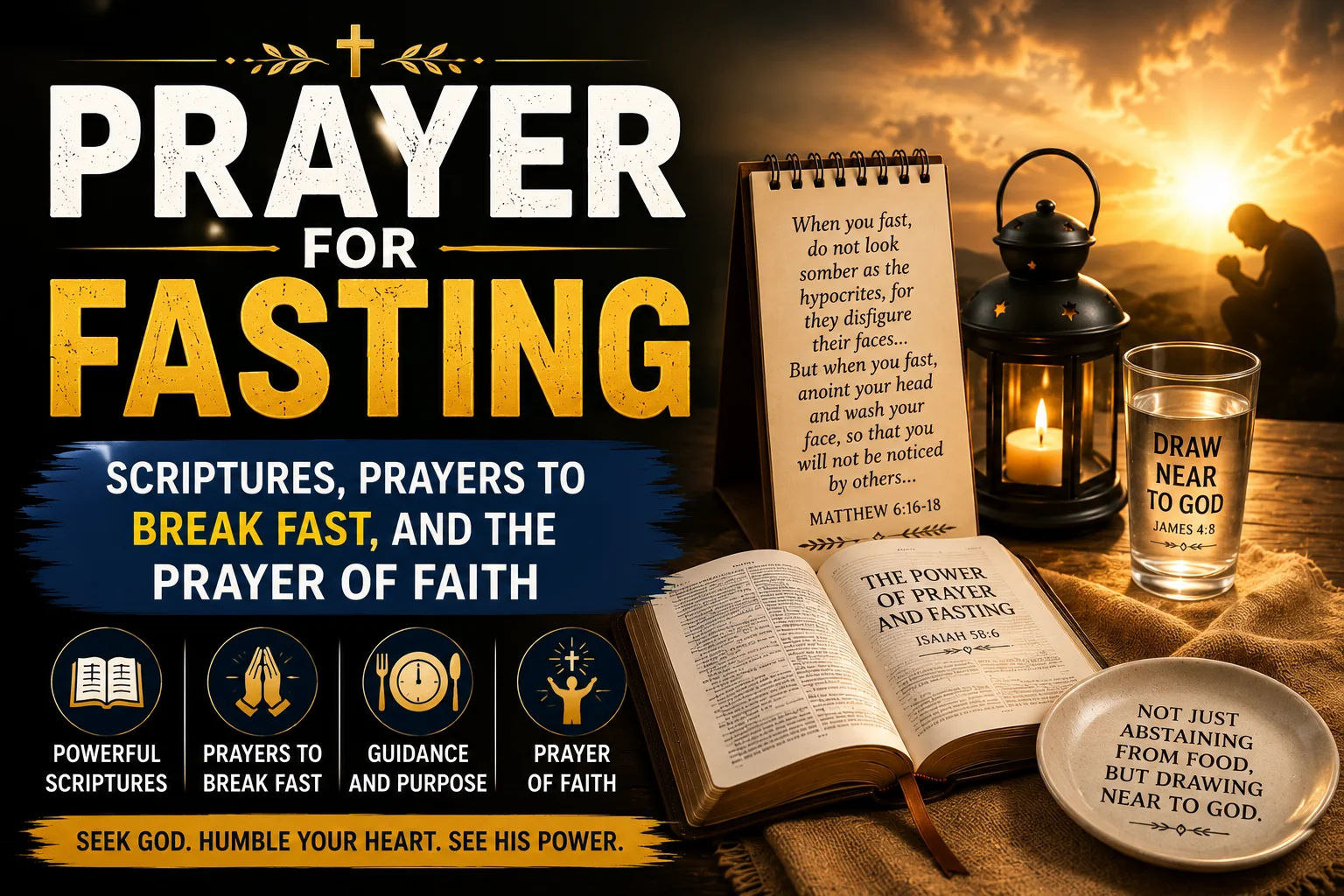
This guide gives you prayers for every stage of a fast — the opening, the difficult middle, the prayer to break fast, the Daniel fast, corporate fasting, and the prayer of faith that James connects directly to healing. Every prayer comes with Scripture and the meaning behind it.
What Fasting Is — And What It Is Not
Before the prayers, a clear foundation.
| What Fasting IS | What Fasting Is NOT |
|---|---|
| A voluntary act of humility before God | A way to earn God’s attention or manipulate His response |
| Redirecting physical hunger toward spiritual seeking | Punishment for past sin or spiritual failure |
| A discipline that sharpens spiritual sensitivity | A guaranteed formula for getting what you pray for |
| Available to all believers at any maturity level | Only for the spiritually advanced |
| Accompanied by prayer — the two always go together in Scripture | Dieting with a spiritual label |
| Something Jesus assumed His followers would practice | Optional for “serious” Christians only |
Isaiah 58 is the most important passage on fasting in the Old Testament — and God’s words there are sharp. He rejects fasting that is performative, self-focused, or disconnected from justice and compassion. The fast He chooses, He says, is one that “loosens the chains of injustice” and “frees the oppressed.” Fasting is not about impressing God with your hunger. It is about orienting your whole life toward what matters to Him.
Types of Christian Fasting — A Quick Guide
| Type of Fast | What It Involves | Biblical Example |
|---|---|---|
| Complete fast | No food or water for a limited time | Esther 4:16 — three days |
| Normal fast | No food, water only | Jesus — 40 days (Matthew 4:2) |
| Partial fast | Restricted food (certain foods or meals) | Daniel 1:12 — no meat/wine |
| Daniel fast | Vegetables, fruits, water only | Daniel 10:3 |
| Intermittent fast | Specific hours without food | Common modern practice |
| Media/social fast | Giving up screens, social media | Contemporary application of the principle |
| Corporate fast | A group or church fasting together | Joel 2:15–16 |
Note: Always consult a doctor before beginning any extended food fast, especially if you have health conditions.
Opening Prayer Before Beginning a Fast
“Father, I am beginning a fast. Not to impress You — You are not moved by hunger. Not to punish myself — You are not asking for that.
I am fasting because I want to be closer to You than ordinary days allow. Because there is something I am seeking that requires more of me than the usual routine. Because I want my body to say what my spirit means: You matter more than this.
Consecrate this fast. Let every moment of hunger be a reminder to pray. Let every craving that goes unmet turn my attention toward You. And let what begins today accomplish what You intended when You designed this discipline.
In Jesus’ name, Amen.”
Bible Verse:
“When you fast, put oil on your head and wash your face, so that it will not be obvious to others that you are fasting, but only to your Father, who is unseen; and your Father, who sees what is done in secret, will reward you.” — Matthew 6:17–18
SECTION 1: Prayers for Fasting and Spiritual Breakthrough
Prayer 1 — For Spiritual Breakthrough
“Lord, I am fasting because something in my life needs to break. Not the surface issue — the root. The thing underneath the thing.
You said this kind comes out only by prayer and fasting. So here I am — hungry and praying. Do what ordinary prayer alone has not yet accomplished. In Jesus’ name, Amen.” — “This kind can come out only by prayer and fasting.” — Matthew 17:21
Prayer 2 — For Clarity and Direction
“Father, I am fasting because I need to hear from You more clearly. The noise of daily life — the appetite, the distraction, the busyness — has made it hard to hear. I am quieting myself. Speak. Give me the direction I have been asking for. In Jesus’ name, Amen.” — “Whether you turn to the right or to the left, your ears will hear a voice behind you, saying, ‘This is the way; walk in it.'” — Isaiah 30:21
Prayer 3 — For Humility and Repentance
“Lord, I fast to humble myself before You. Not because humility impresses You, but because pride distances me from You. And I do not want that distance.
Search me. Show me what I have been too comfortable to examine. And let this fast begin the kind of repentance that produces real change. In Jesus’ name, Amen.” — “When I wept and humbled myself with fasting, I was mocked.” — Psalm 69:10 (David fasted in genuine grief before God — this is the model)
SECTION 2: The Daniel Fast — Prayers and Scripture
The Daniel Fast is one of the most popular forms of Christian fasting today — a partial fast based on Daniel’s practice of eating only vegetables and drinking only water for a set period.
What the Bible says:
“I ate no choice food; no meat or wine touched my lips; and I used no lotions at all until the three weeks were over.” — Daniel 10:3
Daniel fasted during a period of intense intercession for his people. He was seeking God’s answer about Israel’s future. The fast was not about diet — it was about devotion. The restriction of food was a physical expression of the total orientation of his attention toward God.
Prayer at the Beginning of a Daniel Fast:
“Father, I begin this Daniel fast with the same posture Daniel carried — seeking Your face on behalf of something greater than myself. I am restricting my eating not as a diet but as a declaration: I want Your answers more than I want comfort.
Like Daniel, I will set my mind to understand. Like Daniel, I will humble myself before You. And like Daniel, I trust that Your answer is already moving toward me — even when I cannot yet see it. In Jesus’ name, Amen.” — “Since the first day that you set your mind to gain understanding and to humble yourself before your God, your words were heard.” — Daniel 10:12
Prayer During the Daniel Fast — When It Feels Long:
“Lord, the fast is not finished yet. And I am feeling the weight of it — the limitation, the craving, the moment when it would be easier to stop than to continue.
Remind me why I started. Give me the endurance of Daniel — three weeks of faithful fasting because the answer was worth the wait. Let me not quit at the door of the breakthrough. In Jesus’ name, Amen.”
SECTION 3: Prayer When Fasting Feels Hard
This is the most honest section in the guide — and the most needed. Nobody talks about this part.
“God, I want to be honest. Fasting is hard today. The hunger is real. The craving is louder than my prayer. The spiritual breakthrough I was hoping to feel is not obvious.
I am not quitting. But I am struggling.
The disciples fell asleep in Gethsemane when Jesus asked them to watch and pray. They were willing — the flesh was weak. I understand that now.
Help me. Not just to endure the hunger, but to actually use it. Let every pang be a prayer. Let every moment of discomfort be a turning toward You.
In Jesus’ name, Amen.”
Bible Verse:
“Watch and pray so that you will not fall into temptation. The spirit is willing, but the flesh is weak.” — Matthew 26:41
SECTION 4: Fasting and Prayer Scriptures — The Full Biblical Foundation
| Scripture | What It Says About Fasting | Application |
|---|---|---|
| Matthew 6:16–18 | Fast privately, for God not for appearance | The motive of fasting |
| Isaiah 58:6–7 | True fasting loosens injustice, feeds the hungry | Fasting must connect to action |
| Daniel 9:3 | Daniel combined fasting with prayer and repentance | Model for fasting posture |
| Joel 2:12 | Return to God with fasting, weeping, and mourning | Corporate and national fasting |
| Esther 4:16 | Three-day fast before approaching the king | Fasting before high-stakes moments |
| Matthew 17:21 | Some breakthroughs come only through prayer and fasting | When prayer alone is not producing breakthrough |
| Acts 13:2–3 | Fasting accompanies major spiritual decisions | Before calling/sending leaders |
| Luke 2:36–37 | Anna fasted and prayed night and day | Lifetime fasting as a spiritual practice |
| 1 Corinthians 7:5 | Fasting together as a couple to devote to prayer | Marital fasting |
| Nehemiah 1:4 | Nehemiah fasted when he heard of Jerusalem’s devastation | Fasting out of grief and intercession |
SECTION 5: The Prayer of Faith — James 5:15
The prayer of faith is directly connected to fasting and healing in James 5 — one of the most specific passages in the New Testament about praying for results.
“And the prayer offered in faith will make the sick person well; the Lord will raise them up. If they have sinned, they will be forgiven.” — James 5:15
What the prayer of faith is:
The prayer of faith is not a formula that forces God’s hand. It is prayer offered from a position of genuine trust — trust that God is willing, that He is able, and that what you are asking is within His character and His will. It requires:
- Specific request — not vague hopes but named needs
- Genuine belief — not performance of certainty but actual trust
- Alignment with God’s will — “not my will but Yours” is never absent from genuine faith
- Community — James 5 places this prayer in the context of elders praying together, not solo spiritual effort
Prayer of Faith — For Healing:
“Lord, I bring this specific need before You with everything I have. I am not pretending to have more faith than I do. I am bringing what I have — genuine, imperfect, honest faith.
You are the God who heals. You are willing. You are able. And I ask You — specifically, boldly, and in the name of Jesus — for [specific need].
I receive the answer with open hands. Not demanding my timeline. Not requiring a particular method. But trusting that what You do in response to this prayer is good.
In Jesus’ name, Amen.”
SECTION 6: Prayer to Break Fast
This is the most overlooked prayer in all of Christian fasting practice. Almost no one writes about it. Almost no competitor includes it. But it matters.
Breaking fast is not simply eating again. It is a moment of acknowledgment — of what God did during the fast, of gratitude for His provision, and of transition from a set-apart time back into ordinary life.
Prayer to Break Fast — Short:
“Father, this fast is complete. Thank You for sustaining me through it. Thank You for what You did in the unseen space of these days. As I now receive this food with gratitude, let everything this fast accomplished remain. The clarity. The closeness. The answers still being worked out. In Jesus’ name, Amen.”
Prayer to Break Fast — Full:
“Lord, I stand at the end of this fast with a grateful heart.
I do not know everything You accomplished during these days. Some of it I will understand only in hindsight. But I believe that the time I spent seeking You was not wasted — that Your Word is true when it says You reward those who diligently seek You.
As I receive this food now — this ordinary, material, necessary gift — let me carry forward what the fast produced. The hunger for You that outlasts the hunger for food. The sensitivity to Your Spirit that came with the quieting of other appetites. The prayers that were prayed and are still being answered.
Thank You for this fast. And thank You for this meal. In Jesus’ name, Amen.”
Bible Verse:
“He rewards those who earnestly seek Him.” — Hebrews 11:6
SECTION 7: Corporate and Group Fasting Prayer
When a church, small group, or family fasts together, the spiritual impact multiplies. Joel 2:15–16 calls for a sacred assembly — a corporate fast. This prayer is for that gathering.
“Lord, we come before You together. Not each of us individually in our own corners, but as one body — one community — seeking Your face.
You said that where two or three gather in Your name, You are present. We believe that. We believe that what we seek together has a weight and a reach that individual prayer carries differently.
We are fasting as a church. As a group. As a family. United in hunger for what only You can give.
Hear us. Move in our midst. And let what You do in this season become a testimony that this community carries forward. In Jesus’ name, Amen.”
Bible Verse:
“Blow the trumpet in Zion, declare a holy fast, call a sacred assembly.” — Joel 2:15
A Practical Fasting Prayer Schedule
| Time | Focus | Suggested Prayer |
|---|---|---|
| Opening — Day 1 morning | Consecration and intent | Opening prayer above |
| Each meal skipped | Turn hunger into prayer | Short prayer: “Lord, this hunger is my prayer” |
| Mid-fast (when hardest) | Perseverance and honesty | Section 3 prayer |
| Morning of each fasting day | Scripture and seeking | Daniel 10:12 — “Your words were heard” |
| Final day | Thanksgiving and expectation | “Lord, I have sought You. Thank You for meeting me.” |
| Breaking fast | Gratitude and transition | Full break-fast prayer above |
Frequently Asked Questions
Q: What is the prayer for fasting?
The most important prayer when fasting is the opening consecration — setting apart the fast for God’s purposes rather than simply enduring hunger. This guide’s opening prayer covers that. The prayer should name what you are seeking, acknowledge dependence on God, and commit the fast to His purposes rather than your desired outcome.
Q: What does the Bible say about fasting and prayer?
Matthew 6:16–18 gives Jesus’s direct instruction — fast privately, humbly, and for God. Isaiah 58 gives the broader purpose — fasting connected to justice and genuine devotion. Daniel, Esther, Anna, Paul, and the early church all demonstrate fasting as a regular accompaniment to serious prayer. The Bible treats fasting as a normal part of the believer’s spiritual life.
Q: What is the prayer to break fast?
Breaking fast deserves its own prayer — an acknowledgment of what God did during the fast, gratitude for His provision, and intentional transition from a set-apart time back into daily life. Both versions — short and full — appear in Section 6. This is one of the most neglected aspects of fasting practice.
Q: What is the Daniel Fast?
The Daniel Fast is based on Daniel 10:3 — a partial fast where Daniel ate only vegetables and drank only water for three weeks. It is a popular form of Christian fasting that is more sustainable than a complete fast while still being a genuine act of consecration. Section 2 of this guide covers the Daniel Fast specifically with prayers for beginning and sustaining it.
Q: What is the prayer of faith in James 5?
James 5:14–15 describes elders praying over the sick with anointing oil, and says “the prayer offered in faith will make the sick person well.” The prayer of faith is specific, genuine, and offered in trust — not demanding God’s method or timeline but genuinely believing He is willing and able. Section 5 of this guide covers this in full.
Q: How long should a fast be?
Scripture shows fasts ranging from part of a day (1 Samuel 7:6) to three days (Esther 4:16) to twenty-one days (Daniel 10:3) to forty days (Moses and Jesus). The length should match the purpose and your physical capacity. If you are new to fasting, begin with a single meal or a one-day fast and build from there. Always consult a doctor before extended fasting.
Conclusion
The food is not the point.
The hunger is not the goal. The discipline is not the accomplishment. The willpower required to skip meals is not what makes fasting spiritually valuable.
What makes fasting valuable is what happens when you redirect the appetite. When the moment of craving becomes a moment of prayer. When the empty stomach makes the spirit more alert. When the physical sensation of needing something becomes the most honest expression of needing God.
That is what every biblical faster understood. Daniel was not fasting to prove his discipline. Esther was not fasting to demonstrate religious seriousness. Jesus was not fasting to earn the Father’s approval. They were fasting because what they were seeking was worth the hunger required to seek it.
What are you seeking?
Whatever it is — bring it to this fast with honesty, with Scripture, with the prayer of faith, and with the patience to let God respond in His way and His timing.
The One who sees in secret will reward what is done in secret.
“He rewards those who earnestly seek Him.” — Hebrews 11:6

Albert Matha is a dedicated writer and the voice behind PrayerLifeHub, sharing meaningful prayers and faith-based content to inspire hope, healing, and spiritual growth. He is passionate about helping individuals and couples find peace, strength, and guidance through the power of prayer.