You know the feeling.
It is not dramatic. It does not usually come with thunder or a moment of crisis. It arrives quietly — in the car on the way home, in the middle of the night, in the gap between who you know you should be and who you have been acting like.
Something is not right between you and God. And you know it.
That quiet knowing — that interior conviction — is not something to run from. It is actually one of the most valuable things a person can experience. Because it means the door back is right in front of you.
Repentance is not about punishment. It is not about convincing God to love you again — He never stopped. It is about turning around. The Hebrew word for repentance is teshuvah — literally, “return.” The Greek word in the New Testament is metanoia — a change of mind, a change of direction.
You were going one way. Now you turn and go another.
That turning begins with prayer.
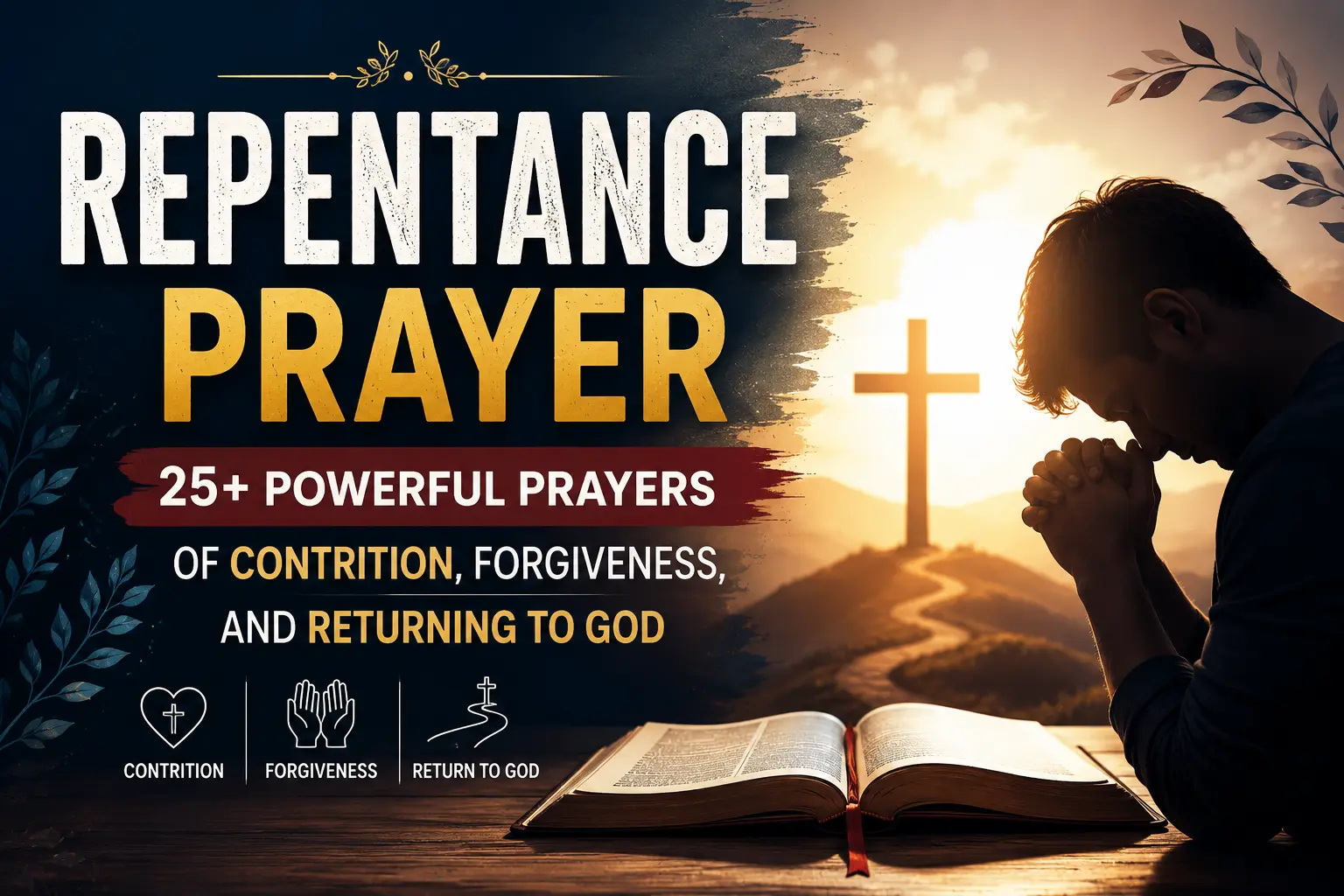
This guide gives you 25+ repentance prayers — for personal sin, for specific struggles, for Catholic confession, for the shame that makes repentance feel impossible, and for the daily practice of keeping the slate clean. Every prayer comes with a Bible verse and the meaning behind it. Because repentance is not just something you do in a crisis — it is a way of moving through life with an honest, open heart before God.
What Is Repentance — And What It Is Not
Before the prayers, it is worth being clear about what genuine repentance actually involves. Because a lot of people carry a distorted picture of it.
| What Repentance IS | What Repentance Is NOT |
|---|---|
| A change of direction — turning away from sin toward God | A feeling of being punished |
| Honest acknowledgment of what was wrong | Endless self-condemnation after forgiveness is given |
| Motivated by love for God, not only fear of consequences | Performance for God’s approval |
| Followed by genuine effort to change | Saying sorry and doing the same thing tomorrow without intention to change |
| Available every single time you need it | Something you can “use up” through repetition |
| The doorway to freedom and restored relationship | The proof that you are worse than other people |
The apostle Paul draws a distinction that changes how repentance feels:
“Godly sorrow brings repentance that leads to salvation and leaves no regret, but worldly sorrow brings death.” — 2 Corinthians 7:10
Worldly sorrow is feeling bad because you got caught, because of consequences, or because you look bad. It produces shame, self-focus, and often more sin.
Godly sorrow is grief over the fact that your actions wounded your relationship with God and with others. It produces honesty, humility, and genuine change.
The difference matters. One leads somewhere. The other loops.
Psalm 51 — The Bible’s Greatest Repentance Prayer
Before any other prayer in this guide, there is Psalm 51.
King David wrote it after the worst moral failure of his life — adultery with Bathsheba and the orchestrated death of her husband Uriah. By every human standard, David had disqualified himself from God’s favor. What he wrote instead became one of the most honest and enduring prayers in all of Scripture.
“Have mercy on me, O God, according to your unfailing love; according to your great compassion blot out my transgressions. Wash away all my iniquity and cleanse me from my sin.
For I know my transgressions, and my sin is always before me. Against you, you only, have I sinned and done what is evil in your sight…
Cleanse me with hyssop, and I will be clean; wash me, and I will be whiter than snow…
Create in me a pure heart, O God, and renew a steadfast spirit within me. Do not cast me from your presence or take your Holy Spirit from me. Restore to me the joy of your salvation and grant me a willing spirit, to sustain me.
The sacrifices of God are a broken spirit; a broken and contrite heart, O God, you will not despise.” — Psalm 51:1–4, 7, 10–12, 17
What Psalm 51 teaches about repentance:
- David does not minimize what he did. He names it.
- He does not bargain or offer his good deeds as compensation.
- He appeals to God’s character — unfailing love, great compassion — not his own.
- He asks not just for forgiveness but for transformation — a pure heart, a renewed spirit.
- He understands that the only offering God truly wants is an honest, broken heart.
This is the model. Every repentance prayer in this guide follows the same movement.
Opening Repentance Prayer
“Father, I come to You not because I have earned this moment, but because You said I could. Your Word promises that if I confess, You are faithful and just to forgive and to cleanse. I am counting on that promise right now.
I have not been who I should be. In some ways that are specific and named. In other ways that are subtle — patterns I have tolerated, attitudes I have excused, distances from You I have let grow comfortable.
I am not coming with excuses. I am coming with honesty.
Forgive me. Cleanse me. Restore what has been damaged between us. And give me, not just clean hands, but a changed heart.
In Jesus’ name, Amen.”
Bible Verse:
“If we confess our sins, He is faithful and just to forgive us our sins and to cleanse us from all unrighteousness.” — 1 John 1:9
SECTION 1: Personal Repentance Prayers
Prayer 1 — General Repentance
“Lord, I confess that I have sinned against You — in what I have done and in what I have left undone. In words I should not have spoken and in silence I should have broken.
I am not coming to negotiate. I am coming to confess.
Forgive me according to Your great mercy. Wash me clean. Not just the visible parts — the hidden ones too. The attitudes I have carried that I have not admitted even to myself.
Make me new. In Jesus’ name, Amen.” — “Have mercy on me, O God, according to your unfailing love; according to your great compassion blot out my transgressions.” — Psalm 51:1
Prayer 2 — For Repeated Sin
“Father, I have been here before. And that is the hardest part of this prayer — the honesty that this is not the first time I have repented for this same thing.
I do not want to cheapen repentance by treating it as a reset button without real change. So I am asking for more than forgiveness today. I am asking for the deep work — the transformation of the desire itself, not just the behavior.
Break the cycle, Lord. Not just for today, but at the root. In Jesus’ name, Amen.” — “I will give you a new heart and put a new spirit in you; I will remove from you your heart of stone and give you a heart of flesh.” — Ezekiel 36:26
Prayer 3 — When Shame Makes Repentance Feel Impossible
“God, I want to come to You but I feel too far gone. The shame says that what I have done has changed how You see me. The guilt says that showing up now would be presumptuous.
But Your Word says something different. It says You are the Father who runs toward the returning son. It says nothing can separate me from Your love. It says Your mercies are new every morning — and that means this morning, for this.
I am choosing to believe that instead of what shame is telling me. Here I am. In Jesus’ name, Amen.” — “But while he was still a long way off, his father saw him and was filled with compassion for him; he ran to his son, threw his arms around him and kissed him.” — Luke 15:20
Prayer 4 — For Pride
“Lord, I repent of pride. The kind that would rather be right than reconciled. The kind that finds it harder to say ‘I was wrong’ than almost anything else. The kind that has quietly placed my own judgment above Yours in more ways than I have admitted.
Humble me. Not harshly — but completely. Replace the pride with the kind of confidence that does not need to win. In Jesus’ name, Amen.” — “God opposes the proud but shows favor to the humble.” — James 4:6
Prayer 5 — For Anger and Words Spoken in Anger
“Father, I have used my words as weapons. Things said in anger that I cannot unsay. Tones of voice that communicated contempt when love was what the moment needed.
I am sorry. Not just for the consequences — for the choice. Forgive me for what I said. Help me repair what it damaged. And build in me the patience that does not reach for anger as a first response. In Jesus’ name, Amen.” — “My dear brothers and sisters, take note of this: Everyone should be quick to listen, slow to speak and slow to become angry.” — James 1:19
Prayer 6 — For Lust and Sexual Sin
“Lord, I bring this before You even though it is uncomfortable to name. I have entertained thoughts, consumed content, or acted in ways that dishonored You and the dignity of people made in Your image.
Forgive me. Not just for the act but for what led to it — the moments of choice I walked through before arriving there.
Create in me a clean heart. Guard my eyes and my mind. And help me build the kind of accountability structures that put distance between me and the patterns I keep returning to. In Jesus’ name, Amen.” — “Flee from sexual immorality… you were bought at a price. Therefore honor God with your bodies.” — 1 Corinthians 6:18–20
Prayer 7 — For Dishonesty
“Father, I have not always told the truth. Sometimes in outright lies. More often in the half-truths, the omissions, the way I shaped facts to protect myself or my reputation.
You are a God of truth. And my dishonesty has put distance between us.
Forgive me. And give me the courage to be honest — even when honesty costs me something. In Jesus’ name, Amen.” — “The Lord detests lying lips, but He delights in people who are trustworthy.” — Proverbs 12:22
SECTION 2: The Prodigal Son Prayer — Returning After a Long Absence
This prayer is for the person who has been away from God for months or years. Not just struggling — genuinely distant. The prodigal son’s prayer in Luke 15 is the model: “Father, I have sinned against heaven and against you. I am no longer worthy to be called your son.”
“Father, I have been gone. Not just in one moment of failure, but in a long slow drift that I chose and then stopped noticing.
I traded Your presence for things that promised more and delivered less. I told myself I would come back when things were better, when I was better. But here I am — not better, just honest.
I am not coming because I have cleaned myself up. I am coming because I cannot clean myself up. That is what brought the prodigal son home — not success, but need.
Receive me back. Not as someone who earned the right to return. As someone who simply ran out of reasons to stay away.
I am Yours again. In Jesus’ name, Amen.”
Bible Verse:
“But while he was still a long way off, his father saw him and was filled with compassion for him; he ran to his son, threw his arms around him and kissed him.” — Luke 15:20
SECTION 3: Catholic Repentance Prayers
The Act of Contrition — Traditional Version (USCCB)
The Act of Contrition is the foundational Catholic prayer of repentance — prayed before and during the Sacrament of Confession.
“O my God, I am sorry and repent with all my heart for all the wrong I have done and for the good I have failed to do, because by sinning I have offended you, who are all good and worthy to be loved above all things. I firmly resolve, with the help of your grace, to do penance, to sin no more, and to avoid the occasions of sin. Through the merits of the Passion of our Savior Jesus Christ, Lord, have mercy.”
The Act of Contrition — Shorter Traditional Version
“O my God, I am heartily sorry for having offended Thee, and I detest all my sins because of Thy just punishments, but most of all because they offend Thee, my God, who art all good and deserving of all my love. I firmly resolve, with the help of Thy grace, to sin no more and to avoid the near occasions of sin. Amen.”
What the Act of Contrition Is Doing
The Act of Contrition contains three essential movements. Understanding them transforms it from a memorized formula into a genuine prayer:
| Movement | What It Says | Why It Matters |
|---|---|---|
| Acknowledgment | “I am sorry and repent with all my heart” | Repentance is not partial — it is a whole-heart turning |
| Motivation | “Most of all because they offend Thee, my God” | The deepest contrition is motivated by love for God, not just fear of punishment |
| Resolution | “I firmly resolve… to sin no more” | True repentance includes intention to change — not just regret |
The prayer does not claim perfect future behavior. It says “I firmly resolve, with the help of your grace” — acknowledging that the resolution itself requires divine assistance.
Prayer Before Catholic Confession
“Lord, I am preparing to enter the Sacrament of Reconciliation. Before I speak to the priest, I speak to You first.
Open my conscience clearly. Help me see my sins not through the lens of what I can justify, but through the lens of Your holiness and love. Give me genuine contrition — not just embarrassment at being in the confessional, but real sorrow that I have wounded what You gave Your Son to restore.
And help me receive the absolution not as a formality, but as what it actually is: Your forgiveness, spoken through a human voice.
I am ready. In Jesus’ name, Amen.”
Bible Verse:
“If you forgive anyone’s sins, their sins are forgiven; if you do not forgive them, they are not forgiven.” — John 20:23
Prayer for a Good Confession (Before Entering the Confessional)
“Holy Spirit, guide my examination of conscience. Help me remember what I need to confess without omitting what is uncomfortable. Give me humility to be honest with the priest. And give me trust that what happens in that confessional is real — that the absolution I receive is genuinely from You.
Remove any shame that would make me hold something back. You already know it. I am just agreeing with what You already see. In Jesus’ name, Amen.”
SECTION 4: Prayer of Contrition — Protestant and General Christian
Prayer 8 — Contrition Rooted in God’s Character
“Father, I come to You not on the strength of my sorrow — which is imperfect — but on the strength of Your character, which is not.
You are faithful. You are just. You promised to forgive when I confess. I am confessing.
Whatever I have done — the sins I know clearly and the ones I have not yet seen — I bring them all before You now. Cover them with the blood of Jesus. And let what He accomplished on the cross be fully applied to this moment in my life. In Jesus’ name, Amen.” — “He is faithful and just to forgive us our sins and to cleanse us from all unrighteousness.” — 1 John 1:9
SECTION 5: Prayer for National and Corporate Repentance
“Lord, I come before You not only for my own sins but for the sins of my community, my nation, my church.
We have tolerated injustice and called it policy. We have accumulated wealth and ignored the poor. We have used Your name for our own agendas. We have divided what You called to be united.
Your Word says that if Your people humble themselves and pray and seek Your face and turn from their wicked ways, You will hear from heaven and heal the land.
I am one person. But I am standing in the gap for more than myself. Hear this prayer as the beginning of something — a turning that starts here. In Jesus’ name, Amen.”
Bible Verse:
“If my people, who are called by my name, will humble themselves and pray and seek my face and turn from their wicked ways, then I will hear from heaven, and I will forgive their sin and will heal their land.” — 2 Chronicles 7:14
SECTION 6: Short Daily Repentance Prayers
Not every repentance prayer needs to be lengthy. The daily practice of brief, honest examination keeps the soul clean and the relationship with God current.
Morning examination: “Lord, before this day begins — search me. Show me anything from yesterday that needs to be named and surrendered. I want to start this day with nothing between us. Amen.”
Evening examination: “Father, as today ends, I bring You the moments I handled poorly. The impatient response. The missed opportunity to be kind. The choice I knew was wrong. Forgive them all. And give me a cleaner tomorrow. Amen.”
In a moment of fresh sin: “God, I just did it again. I am not waiting until tonight to bring this to You. Forgive me now. Help me now. I turn around right now. Amen.”
When conviction is strong: “Lord, Your Spirit is convicting me and I am not going to ignore it. Whatever this is — whatever You are pointing to — I am willing to see it and surrender it. Search me and know me. In Jesus’ name, Amen.”
Bible Verses Quick Reference for Repentance
| Bible Verse | Focus | When to Use |
|---|---|---|
| 1 John 1:9 — “If we confess, He is faithful to forgive” | God’s guaranteed response to confession | Opening any repentance prayer |
| Psalm 51:10 — “Create in me a pure heart” | Transformation, not just forgiveness | When behavior needs to change at the root |
| 2 Corinthians 7:10 — “Godly sorrow brings repentance” | Understanding true vs false contrition | Before examining motivation |
| Luke 15:20 — “His father ran to him” | Returning after long absence | Prodigal son prayer |
| Ezekiel 36:26 — “A new heart… a new spirit” | Deep transformation of desire | For repeated sin |
| James 4:6 — “God gives grace to the humble” | Humility as the door to forgiveness | Pride repentance |
| 2 Chronicles 7:14 — “Humble themselves and pray” | National/corporate repentance | Praying for a nation |
| Isaiah 1:18 — “Though your sins are like scarlet, they shall be white as snow” | The extent of God’s forgiveness | When sin feels too great to be forgiven |
| Proverbs 28:13 — “Whoever conceals sin will not prosper” | The cost of unconfessed sin | When avoidance has been chosen |
| Acts 3:19 — “Repent and turn to God, that your sins may be wiped out” | The result of repentance | Encouragement after confession |
How to Know If Your Repentance Is Genuine
One of the most honest questions a person can ask is: Am I actually repenting, or am I just sorry about consequences?
| Sign of Genuine Repentance | Sign of Worldly Sorrow Only |
|---|---|
| Sorrow is directed toward God — “I have sinned against You” | Sorrow is directed toward self — “I hate myself for this” |
| Willing to make specific, named confession | Keeps the confession vague and general |
| Includes intention to change behavior | Only addresses feeling, not direction |
| Willing to accept accountability | Resists accountability from others |
| Peace follows confession | Guilt continues even after confessing |
| The same situation handled differently next time | Pattern continues despite repeated confession |
Genuine repentance does not always feel dramatic. Sometimes it is quiet and honest and undramatic — just the sincere turning of a heart that was going the wrong way and has decided to go another.
Frequently Asked Questions
Q: What is a repentance prayer?
A repentance prayer is an honest conversation with God in which you acknowledge sin, express genuine sorrow for having broken your relationship with God and harmed others, and make a sincere commitment — with God’s help — to change direction. It is not a formula or a magic reset. It is the language of a heart that has seen where it went wrong and wants to go right.
Q: What is the difference between repentance and asking for forgiveness?
Forgiveness is what God gives. Repentance is what we bring. Forgiveness removes the guilt of sin. Repentance is the turning — the change of direction — that positions us to receive that forgiveness. You can ask for forgiveness without repenting, but the forgiveness does not do its full work if the direction does not change.
Q: What is the Act of Contrition and when is it prayed?
The Act of Contrition is the Catholic Church’s foundational prayer of repentance — prayed especially before and during the Sacrament of Confession. It contains three essential movements: acknowledgment of sin, motivation rooted in love for God, and a firm resolve to avoid sin in the future. Both the traditional and shorter versions appear in this guide’s Catholic section.
Q: Is repentance only for big sins?
No. The daily examination of conscience — practiced by Catholics and many Protestant Christians — treats repentance as a regular practice, not an emergency response. Martin Luther’s first thesis stated that the entire Christian life is one of repentance. Small patterns of sin, uncharitable thoughts, missed opportunities to love — these belong in repentance prayer too.
Q: What if I keep sinning in the same way after repenting?
This is one of the most common experiences in the Christian life. The answer is not to give up on repentance but to go deeper in it. Prayer 2 in this guide addresses repeated sin specifically — asking not just for forgiveness but for transformation of the desire itself. It is also worth seeking accountability, addressing the root environment or trigger, and being honest with a pastor, spiritual director, or trusted friend.
Q: How do I know God has forgiven me after I repent?
The promise in 1 John 1:9 is unconditional: “If we confess our sins, He is faithful and just to forgive us our sins.” The word faithful here means God does not break this promise. Forgiveness is not based on how you feel after confessing — it is based on what God promised He would do when you did. The feeling of peace often follows, but the forgiveness is established in the moment of sincere confession.
Conclusion
There is a reason the prodigal son’s father was watching the road.
He was expecting the return.
The story does not say the father sat inside hoping his son might eventually show up. He was outside, watching, and when the son appeared still a long way off — he ran. Not walked. Ran.
That is the picture of God that repentance prayer runs toward. Not a judge waiting to pronounce sentence. A Father who has been watching the road, ready to run the moment He sees you turning in His direction.
The door back to God is never locked from His side. It only feels locked from ours — usually because shame or pride is holding it closed.
These prayers are the reaching for the handle.
Pray them honestly. Pray them specifically. Pray them when you feel it deeply and when you do not feel anything at all, because genuine repentance does not always arrive on a wave of emotion. Sometimes it is simply the quiet, courageous decision to stop going in the wrong direction.
Turn around. He is already running toward you.
“Create in me a pure heart, O God, and renew a steadfast spirit within me.” — Psalm 51:10

Albert Matha is a dedicated writer and the voice behind PrayerLifeHub, sharing meaningful prayers and faith-based content to inspire hope, healing, and spiritual growth. He is passionate about helping individuals and couples find peace, strength, and guidance through the power of prayer.